
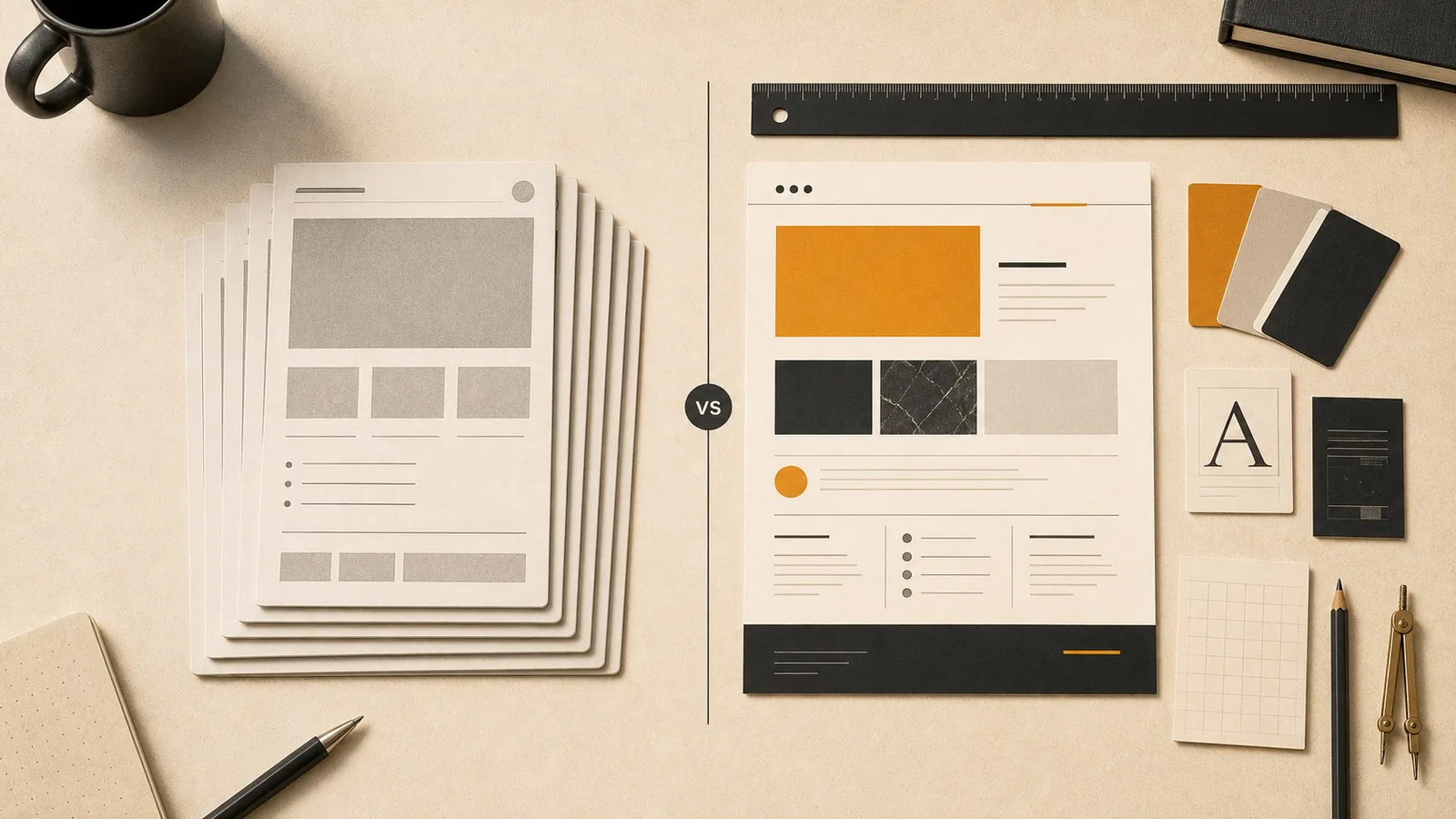
A template reuses an existing system, which can reduce cost and launch time. A custom build gives the team more control over structure and design, but costs more upfront and may require developer support. Ownership depends on the contract, platform and account setup in either approach. Choose based on how often content changes, who will maintain it and which assets you must control.
The custom-versus-template question hides behind almost every website quote. Two providers can both describe their work as “a five-page business website” while delivering fundamentally different things. Understanding what is included in a five-page website, what each approach delivers, and what each gives up is what lets a business owner compare quotes honestly rather than on price alone.
This guide explains what a template website is, what a custom website is, what each does well, what each costs in the long run, and how to choose based on the business’s real needs rather than on the sales pitch.
What a template website actually is
A template website is built on a pre-existing design that is reused across many businesses. The business owner selects a layout from a library, supplies their own content and logo, and the site goes live quickly.
Templates come in two common forms:
- Hosted platform templates (Wix, Squarespace, Shopify): the design and the hosting are bundled, the platform is rented monthly, and the business does not truly own the site.
- Theme-based templates (WordPress themes, theme frameworks): the design is reusable, but the site is hosted separately and can be moved between providers.
The defining feature of a template is that the visual structure, layout and often the code were created for a general market, not for the specific business.
What a custom website actually is
A custom website is built specifically for the business. The layout, structure and visual system are designed around the business’s offer, audience and content, rather than selected from a library.
Custom work spans a range:
- Custom design on a content management system: the visual layer is bespoke, the underlying platform (often a static site generator or a lightweight CMS) is chosen for stability and maintainability.
- Fully bespoke build: the site is hand-coded for the business, with no reused theme or framework.
The defining feature of a custom site is that the design and structure serve the business, not the other way around.
What a template does well
Templates have genuine strengths, and dismissing them entirely is dishonest.
Template strengths
- Speed: a template site can launch in days rather than weeks.
- Lower upfront cost: no design time, so the entry price is lower.
- Predictable structure: the layout is already proven to work for the category it was built for.
- Easier for non-technical owners: hosted platforms include drag-and-drop editing.
- Fast initial setup: hosting, SSL and a domain can be bundled.
For a business that needs a presence quickly, has limited budget, and does not expect to compete heavily on design or search, a template can be a reasonable starting point.
What a template gives up
The trade-offs become visible over time.
Template trade-offs
- Generic appearance: the same template may be in use by hundreds of businesses, including competitors.
- Limited distinctiveness: the brand has to fit the template’s structure, rather than the template fitting the brand.
- Platform lock-in: hosted templates are rented, not owned; moving off the platform usually means rebuilding.
- Monthly costs: hosted platform fees continue forever and often increase.
- Performance limits: templates carry code and features the business does not need, which can slow the site.
- Maintenance risk: theme-based templates depend on the theme developer staying current; abandoned themes become security risks.
These trade-offs are not always decisive, but they compound. The site that launched cheaply in year one can become expensive and limiting by year three.
What a custom website does well
Custom work trades upfront cost for long-term value.
Custom strengths
- Distinctive design: the site looks like the business, not like a template.
- Full ownership: the domain, hosting and code belong to the business.
- Better performance: only the code the site actually needs is shipped.
- Lower ongoing cost: no monthly platform fee, lower maintenance.
- Search-friendly structure: the content and code can be shaped for search from the start.
- Room to grow: the structure can evolve with the business without rebuilding.
The article on what makes a business website look trustworthy covers why distinctiveness matters for credibility; a template’s generic appearance works directly against this.
What a custom website gives up
Custom work is not universally better; it has real trade-offs.
Custom trade-offs
- Higher upfront cost: design and development time are the largest single expense.
- Longer timeline: a custom build takes weeks, not days.
- Less self-service editing: depending on the platform, content updates may require a developer.
- Higher skill requirement: maintenance needs a competent developer, not just an account holder.
For a business that changes content rarely and values ownership, these trade-offs are worth accepting. For a business that wants to edit weekly and launch immediately, they may not be.
How to choose based on the business’s real needs
The choice is not “template bad, custom good.” It is a match between the business’s needs and each approach’s profile.
Choose a template if
- The business needs a presence within days.
- The budget is tightly constrained and the ongoing platform fee is acceptable.
- The business does not expect to compete on design or search.
- The owner wants to edit content regularly without a developer.
- Distinctiveness is not a commercial priority.
Choose a custom build if
- The business wants a site that looks like no competitor’s.
- Long-term ownership and low ongoing cost matter.
- The site is expected to compete in search.
- The content changes infrequently enough that developer-assisted updates are fine.
- Performance and maintainability are priorities.
Most service businesses that plan to operate for several years benefit from a custom build, because the cumulative cost of platform fees and the cumulative cost of generic appearance eventually exceed the upfront saving. But the right answer depends on the business, not on a general rule.
The question that resolves most of the debate
The single most clarifying question is: how often will the content change, and who will change it?
- If the answer is “weekly, by the owner,” a hosted template is often the practical choice despite its trade-offs.
- If the answer is “rarely, by a developer,” a custom build is usually the better long-term value.
This question cuts through most of the sales framing and gets to what actually determines the right fit.
The platform question inside the template question
Templates and custom builds exist across many platforms, and the platform choice interacts with the template-custom choice. The article on whether WordPress is right for your small business website covers the most common platform decision in depth. The short version: WordPress with a theme is a template approach with separate hosting; a custom build on a static platform is a custom approach with lower maintenance.
How this connects to the IDJoy pricing
The IDJoy pricing page reflects both approaches. The 5 Page Website Launch is a focused, structured build rather than a generic template; the Digital Presence package adds branding, email and SEO setup to a coherent custom foundation. Neither is a hosted template rental; both are owned by the business after launch.
This is a deliberate choice. For businesses that expect to operate for several years, ownership and distinctiveness compound in value, while platform fees compound in cost.
The conclusion
A template website and a custom website are not the same product described differently. A template reuses an existing design, launches fast and costs less upfront, but looks generic, is harder to make distinctive, and often locks the business into a rented platform. A custom website is built around the business, is fully owned and is more maintainable long-term, but costs more upfront.
The right choice depends on how often the content will change, who will maintain it, and how much distinctiveness and ownership matter to the business. Compare quotes on these factors, not on price alone, and the comparison becomes honest.
If you want help deciding which approach fits your business, explore the pricing page or describe your situation and we will tell you which approach serves you best.