
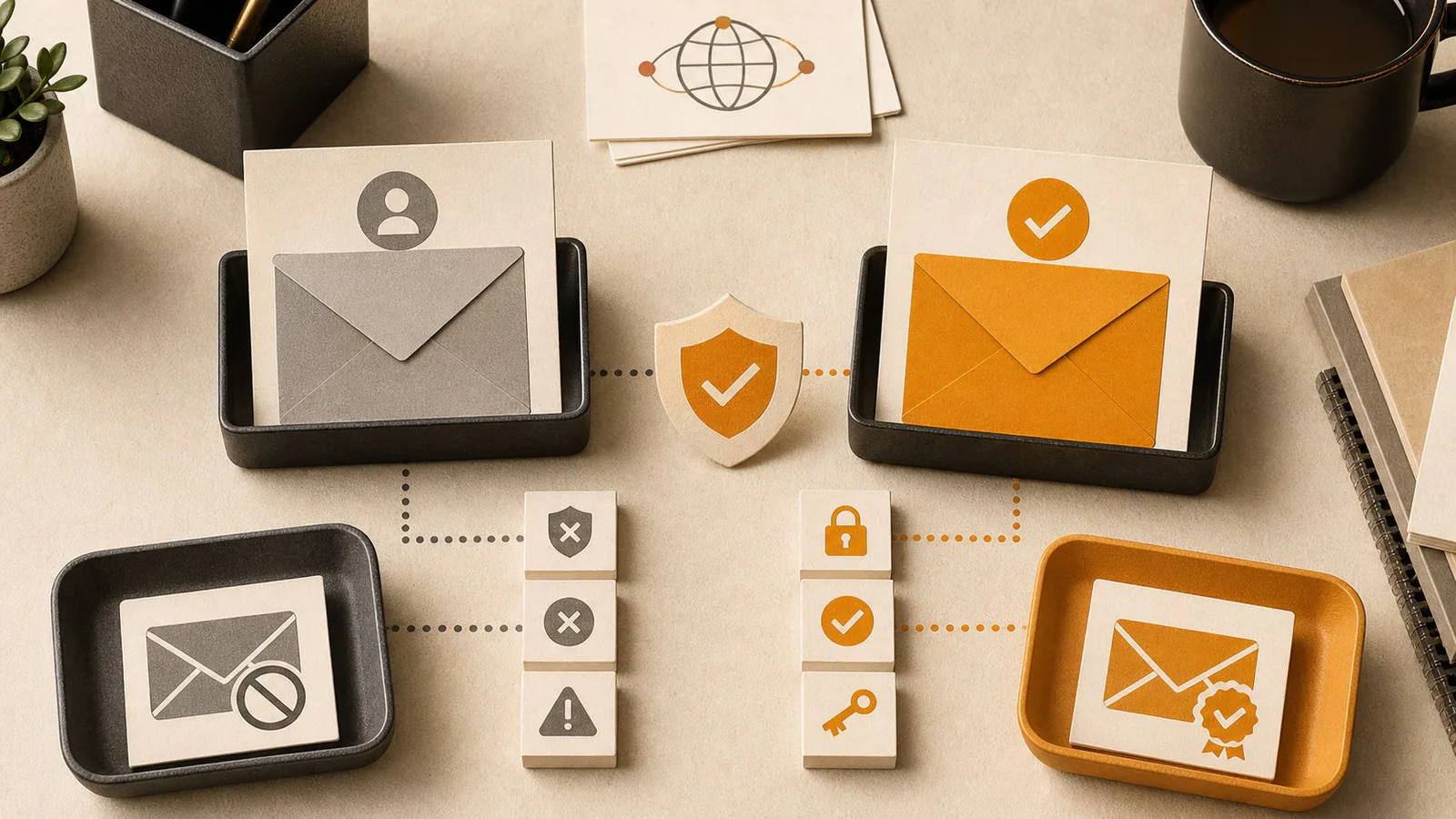
A free Gmail or Yahoo address can make an established business look informal because the address does not match its brand or website. A branded address such as [email protected] gives the business a consistent identity and control over account naming. Deliverability depends on authentication and sender reputation, so configure SPF, DKIM and DMARC during the move.
A free email address is one of the quietest credibility leaks a small business can have. It rarely shows up in a dashboard. It does not break a page. But every time a quote, an invoice or a reply leaves the business from a Gmail, Yahoo or other free address, it sends a small signal that the business is less established than it might be, and it is more likely to be filtered, delayed or ignored than mail from a branded domain.
This guide explains why a free address weakens trust, why it also weakens deliverability, what a branded address actually delivers, and how to make the switch without losing the mail or the contacts already in place.
The two ways a free address costs a business
A free email address costs a business in two distinct ways, and most owners only notice the second.
Cost one: the credibility signal
When a customer receives a quote from [email protected] rather than [email protected], the address itself carries information. A free address suggests, fairly or not, that the business is a side project, newly started, or not invested enough in its own identity to operate from its own domain.
Customers do not always articulate this. They simply file the quote alongside the others and may give less weight to it. In a competitive situation, the business with the branded address starts a step ahead, and the business with the free address starts a step behind, for reasons that have nothing to do with the quality of the work.
Cost two: the deliverability penalty
The second cost is less visible but more damaging. Mail from free addresses is increasingly filtered by receiving providers. A quote sent from a free Gmail address to a corporate inbox is more likely to be flagged, delayed or silently dropped than the same message sent from an authenticated branded domain.
The reasons are technical and covered in detail in the article on why business emails land in spam. The short version: providers like Google and Yahoo now apply stricter sender requirements, and a free address cannot be authenticated with the domain-level records (SPF, DKIM, DMARC) that establish trust. Mail from an unauthenticated free address is treated as higher-risk by default.
What a branded address actually delivers
A branded email address is one that uses the business’s own domain: [email protected], [email protected], [email protected]. It delivers three things a free address cannot.
A stronger first impression
The branded address reinforces the business’s identity at every touchpoint. It appears on quotes, invoices, replies, the website contact page and the email signature. Each appearance is a small confirmation that the business is established and operates from its own domain.
Better deliverability
A branded domain can be authenticated with SPF, DKIM and DMARC, which are the records that tell receiving servers the mail is genuine and unaltered. The Google sender guidelines now treat these records as the baseline expectation, not an optional extra. Mail from an authenticated branded domain lands in the inbox more reliably than mail from a free address.
Full control
A free address belongs to the provider, not the business. The provider can suspend it, change its terms, or shut it down. A branded domain belongs to the business as long as the domain is renewed. The business controls the mailboxes, the routing, the archives and the security, without depending on a third party’s goodwill.
The objections that keep businesses on free addresses
Several reasonable-sounding objections keep businesses on free addresses long after the switch would have paid for itself.
“Customers already know this address”
True, and addressable. A branded address can be set up so that mail sent to the old free address forwards to the new one for a transition period, and the business can reply from the branded address while continuing to receive at both. No customer is lost in the switch.
“It works fine, we have not had complaints”
The absence of complaints is not evidence of success. Customers rarely report that a quote landed in their spam folder; they simply never reply. The cost of filtered mail is invisible until the business starts tracking whether quotes are being received and answered.
“A branded address is expensive”
The domain itself costs a few hundred rand a year. Mailbox hosting from a reputable provider costs a modest monthly amount per user. The Professional Business Email package on the IDJoy pricing page (R1,931.40 for five mailboxes over twelve months, including SPF, DKIM and DMARC setup) is typical of the real cost. Against the cost of a single lost quote or invoice per month, the investment recovers itself quickly.
“We are too small to need it”
The smaller the business, the more each credibility signal matters. A large company can absorb a weak impression; a one-person operation cannot. The branded address is most valuable precisely for small businesses and sole traders, because it does the work of looking established that a larger team would do through scale.
What a branded address requires
Setting up a branded address is straightforward but has to be done properly to deliver the benefits.
The components
- A registered domain in the business’s name (for example,
yourbusiness.co.za). - Mailbox hosting through a reputable provider (Google Workspace, Microsoft 365, or a quality independent host).
- SPF, DKIM and DMARC records published in the domain’s DNS.
- Mailboxes created for the addresses the business needs (hello, accounts, the owner’s name, etc.).
- A migration plan for existing mail and contacts.
The SPF, DKIM and DMARC configuration is the part most often skipped, and it is the part that determines whether the branded address actually delivers better than the free one it replaces. Without authentication, a branded address can land in spam just as readily as a free one.
How to make the switch without losing anything
A migration done well is invisible to customers. A migration done badly loses mail, contacts and trust.
Step 1: Choose and register the domain
If the business does not yet have a domain, register one that matches the brand name as closely as possible. The .co.za namespace is the natural choice for most South African businesses; .com is reasonable where the business trades internationally.
Step 2: Set up mailbox hosting
Choose a provider whose authentication and security meet current standards. Google Workspace and Microsoft 365 are the common choices; quality independent hosts are also viable. Create the mailboxes the business needs.
Step 3: Configure SPF, DKIM and DMARC
Publish the authentication records in DNS, following the monitor-then-enforce sequence described in the SPF, DKIM and DMARC guide. Do not skip this step; it is what makes the branded address more deliverable than the free one.
Step 4: Migrate existing mail and contacts
Most providers offer migration tools that copy existing mail and contacts from the old account. Run the migration before switching the public address, so nothing is lost.
Step 5: Forward the old address during transition
Set the old free address to forward to the new branded one for at least six months. This catches any customer who still uses the old address and lets the business reply from the branded address.
Step 6: Update the public presence
Update the email address on the website, the Google Business Profile, social profiles, invoices, quotes, signatures and any directory listings. Consistency across these reinforces the new address and the domain’s trust signals.
The connection to the wider credibility picture
Email is one part of how a business presents itself as credible. The article on what makes a business website look trustworthy covers the full set of signals a first-time visitor reads, and branded email is consistently among the most impactful because it touches every customer interaction, not just the website visit.
A business that has invested in a credible website but still sends mail from a free address is undermining its own investment at every touchpoint after the visit. The two have to be consistent.
The conclusion
A free email address weakens a business in two ways: it signals smallness or informality to customers, and it lands in spam more often than mail from an authenticated branded domain. A branded address delivers a stronger first impression, better deliverability, and full control of the business’s communication.
The objections that keep businesses on free addresses are addressable: the old address can forward during transition, the cost is modest against the cost of lost mail, and the switch benefits small businesses most. Set up a branded domain, configure SPF, DKIM and DMARC, migrate existing mail, forward the old address, and update the public presence.
If your business is still operating from a free address, the Professional Business Email package includes the domain, mailboxes and authentication setup. Describe your current setup and we will tell you what the switch involves.