
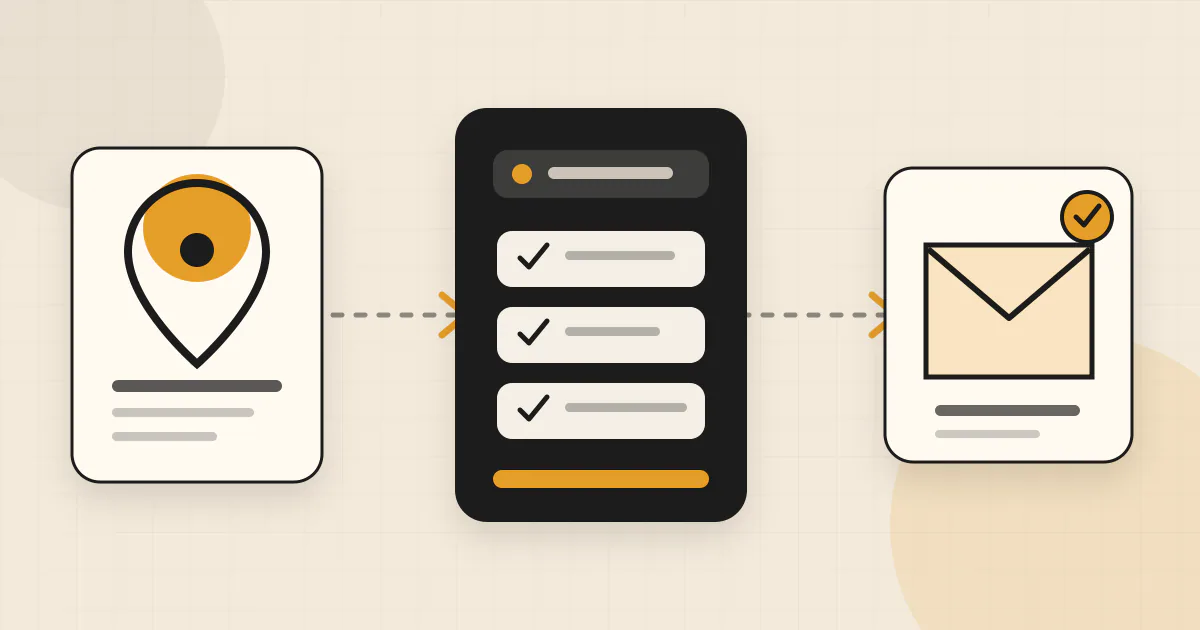
IDJOY used an AI-assisted, human-verified workflow to document 178 South African prospects across two campaigns: 174 print businesses and four Pretoria dental practices. Fifteen outreach emails had been sent at the recorded snapshot. Every address came from a public source, and each prospect had a documented reason for contact. These figures measure researched prospects and outreach activity, not replies, meetings or sales.
Lead generation sounds simple when it is reduced to “find emails and send messages”. The real work sits between those steps.
You need to decide who fits the offer, find a current public contact channel, inspect the business, record a specific reason for contact, prepare a relevant message and follow up without losing the history. A weak process produces a large spreadsheet and very few defensible prospects.
IDJOY used an AI-assisted, human-verified workflow across two South African outreach campaigns. At the recorded snapshot, the campaigns contained 178 prospects with verified public email addresses. IDJOY had sent 15 outreach emails.
Those numbers require a clear boundary. A researched prospect is not a sale. It is not a booked meeting. It is not even a sales-qualified lead until the business responds or takes another qualifying action.
This case study documents the research and outreach process. It does not claim replies, meetings, revenue or conversion rates that the campaign records do not yet support.
The campaign snapshot
| Campaign | Verified prospects | Outreach sent at snapshot | Main audience |
|---|---|---|---|
| Print and production partners | 174 | 11 | South African print businesses and potential agency partners |
| Pretoria dental practices | 4 | 4 | Dental and orthodontic practices with strong public reputations and visible website opportunities |
| Total | 178 | 15 | Two focused South African prospect groups |
The print campaign held 174 valid email prospects. Eleven had received first outreach, and 163 remained in the queued sending plan. The list was divided into three working segments:
- 16 white-label overflow prospects,
- 65 commercial referral prospects,
- 93 standard referral prospects.
The dental campaign contained four Pretoria practices. All four received personalised HTML outreach from IDJOY’s business email account. Their public Google profiles represented an average rating of about 4.9 and 210 reviews in total at the time of research.
These figures describe the campaign records at one point in time. They may change as messages are sent, addresses are corrected and prospects respond.
The problem IDJOY wanted to solve
Generic cold outreach wastes the sender’s time and the recipient’s attention.
The team needed a repeatable process that could answer six questions for every prospect:
- Does this business fit the offer?
- Is the contact information public and current?
- Can we identify a real business or website opportunity?
- Can the message refer to evidence rather than a generic compliment?
- Has this prospect already received outreach?
- When should the next action happen?
AI helped with research, classification and drafting. A person remained responsible for verification, the offer, the final message and the campaign record.
The workflow
1. Define the niche and offer before researching
The print campaign did not begin with “find companies”. It began with partnership routes.
Some businesses could receive overflow web work under a white-label arrangement. Others could refer commercial projects and receive a percentage when the client paid a deposit. The campaign offer recorded a 15% referral share on qualifying projects from R8,000, with white-label delivery available where appropriate.
The dental campaign used a different offer. IDJOY looked for practices with a strong public reputation and a website that could do a better job of presenting services, building trust or converting enquiries.
A clear offer changed the research criteria. The researcher could reject businesses that did not fit instead of filling the spreadsheet for the sake of volume.
2. Use geography and business type to control the search
The dental campaign used a Pretoria geographic boundary and targeted dental or orthodontic practices.
The print campaign grouped businesses by partnership fit. This made the list easier to prioritise and allowed the outreach copy to match the commercial relationship.
Narrow criteria also make AI easier to supervise. A request such as “find leads in South Africa” leaves too much room for irrelevant results. A request with an industry, area, minimum evidence standard and required fields produces work that can be checked.
3. Verify the official business presence
Each prospect needed a current official website or a credible public business listing. The workflow used public sources to confirm:
- business name,
- location or service area,
- official website where available,
- public email address,
- phone number where relevant,
- services and market fit.
The process rejected guessed email patterns. It did not create addresses such as [email protected] simply because the domain existed. An address had to appear on an official website or another current public source connected to the business.
That rule reduced the list, but it improved trust in the records.
4. Record a specific reason for contact
Personalisation did not mean adding the prospect’s name to a template.
The campaign record needed an evidence-backed reason. Examples included a website that did not clearly show the full service range, a weak enquiry path, a public profile with strong customer proof that the website did not use well, or a partnership fit based on the company’s production work.
The reason was stored before the message was drafted. This prevented the copy from inventing a problem to justify the offer.
5. Draft from evidence and keep a consistent structure
AI supported first-draft outreach, but it worked from the research record.
The message structure remained consistent:
- identify the business and why it fits,
- name the observed opportunity,
- explain the relevant IDJOY offer,
- give the recipient a low-friction next step,
- avoid invented urgency or exaggerated promises.
The dental messages used personalised HTML. The print campaign used templates matched to the relevant partnership segment. The final messages were sent from [email protected] rather than a free personal address.
6. Update the tracker after every sent message
The spreadsheet acted as the campaign memory. Each completed send could record:
- message ID,
- outreach status,
- first outreach date,
- next action date,
- template version,
- notes or corrections.
This matters because follow-up depends on reliable state. Without it, the team risks contacting the same prospect twice, missing a reply or sending a follow-up too early.
The print campaign planned batches of 10 emails per weekday at 07:55 in the Africa/Johannesburg timezone. A controlled schedule protected quality and made the tracker easier to maintain.
7. Plan follow-up before the first send
The working follow-up rhythm was:
- first follow-up after seven days,
- second follow-up after 14 days,
- stop or change the next action when the prospect replies.
A follow-up system should respect opt-outs and avoid repeated contact when the recipient has declined. It should also record replies before another scheduled message runs.
Where AI saved time
AI reduced effort in the parts of the workflow that involve reading, sorting and structuring information.
It helped the team:
- turn research into consistent prospect records,
- classify businesses by campaign segment,
- compare websites against a defined checklist,
- draft outreach from recorded evidence,
- maintain the wording and format across a campaign,
- identify missing fields before a message was approved.
The human review still carried the risk. A person checked the source, business fit, email address, claim and final message.
Where AI could have damaged the campaign
A poorly controlled system could have produced a bigger list in less time and lowered the value of every row.
The main failure modes were:
- guessed email addresses,
- outdated websites or closed businesses,
- generic “your website needs improvement” claims,
- invented personalisation,
- duplicate prospects,
- outreach sent without a recorded status,
- automatic follow-ups after a reply,
- messages that ignored South African privacy and direct-marketing obligations.
The workflow used rejection rules because accuracy mattered more than list size.
What the figures prove
The campaign records show that IDJOY can build and operate a structured prospect-research process across different markets.
They prove:
- 178 prospects had publicly verifiable email addresses in the two tracked lists,
- the lists used defined segments and selection criteria,
- 15 first-outreach messages had been sent at the snapshot,
- each campaign had a tracker and follow-up logic,
- the process combined AI assistance with human verification.
The records do not yet prove a response rate, meeting rate, close rate or return on investment. Those metrics need verified campaign outcomes and a longer observation period.
This distinction protects the reader from a common problem in AI lead-generation content: impressive numbers that count generated rows rather than business results.
The measurement plan for the next stage
A useful campaign report should separate activity from outcomes.
Research quality
Track:
- prospects researched,
- contacts verified,
- records rejected,
- duplicate rate,
- percentage with a specific evidence-backed contact reason.
Outreach activity
Track:
- messages sent,
- delivery failures,
- first follow-ups sent,
- second follow-ups sent,
- opt-outs.
Commercial outcomes
Track:
- replies,
- positive replies,
- qualified conversations,
- meetings booked,
- proposals requested,
- projects won,
- revenue and referral fees linked to the campaign.
Only the last group can support a claim that the campaign generated business. The earlier metrics show whether the operating process is healthy enough to reach that point.
How HyperAgent could improve the next campaign
HyperAgent did not power the historical campaign activity described above. IDJOY is evaluating it as a stronger workspace for the next version of the process.
HyperAgent can combine supported models with web research, files, tables, code execution, business integrations, delegated agents, schedules and budget controls. That could support a controlled lead-generation workflow:
- A research agent finds candidate businesses within a strict niche and area.
- A verification agent checks sources and rejects guessed contacts.
- A website-review agent records one defensible opportunity.
- A drafting agent prepares a message from the approved record.
- A human approves every external action.
- A reporting agent updates the campaign summary from the tracker.
The IDJOY referral currently advertises $1,000 in bonus credits for eligible new users. That creates room to test the workflow on a small batch and compare model quality, cost and correction time.
Affiliate disclosure: The HyperAgent link below is an IDJOY referral link. IDJOY may receive a referral benefit when an eligible reader signs up. This does not increase the advertised cost to you. Credits, eligibility and model availability can change.
Test the lead-research workflow with HyperAgent credits
The best AI tools for South African businesses guide compares HyperAgent with ChatGPT, Claude, Gemini, Perplexity and specialist sales tools.
When your agency has no time to generate leads
An agency can understand its ideal client and still fail to build a consistent pipeline. Client work takes priority. Research stops. The spreadsheet becomes stale. Follow-ups happen when someone remembers.
IDJOY can operate the research and outreach layer on behalf of an agency. The service can cover:
- campaign and prospect criteria,
- public-source business research,
- email verification without guessed addresses,
- evidence-backed prospect notes,
- segmented outreach drafts,
- approved message sending,
- status and follow-up tracking,
- campaign reporting.
The agency keeps its positioning, pricing and sales relationship. IDJOY handles the repeated work required to keep qualified prospects moving into the outreach process.
A campaign should begin with a small pilot. Agree on the niche, geography, exclusions, required evidence, approval process and success measures. Review the first batch before increasing volume.
Discuss a done-for-you lead-generation pilot with IDJOY
Privacy and outreach controls
Public contact information does not remove the sender’s responsibilities.
A South African campaign should consider POPIA, direct-marketing requirements, the purpose for collecting contact data, security, relevance, opt-outs and record retention. Legal requirements depend on the channel and circumstances, so businesses should obtain appropriate legal advice for their process.
Operational controls should include:
- use only the data needed for the campaign,
- record the public source,
- protect the spreadsheet and connected accounts,
- honour opt-out requests,
- stop automated follow-ups after a reply,
- review permissions before connecting an AI agent,
- avoid uploading sensitive client or personal information without a lawful and secure process.
AI can perform more actions as tools become more agentic. That increases the need for clear approval boundaries.
The lesson
The useful result was not a promise that AI would generate customers while the team slept. It was a documented process that produced 178 verifiable prospect records across two focused South African campaigns and kept outreach activity traceable.
The next stage is to complete the planned outreach, follow the response data and measure commercial outcomes. HyperAgent can help test a more integrated version of the workflow, while IDJOY can run the process for agencies that do not have the time or internal capacity to manage it.
Lead generation improves when the list, reason for contact, message and follow-up record all come from the same evidence trail.