
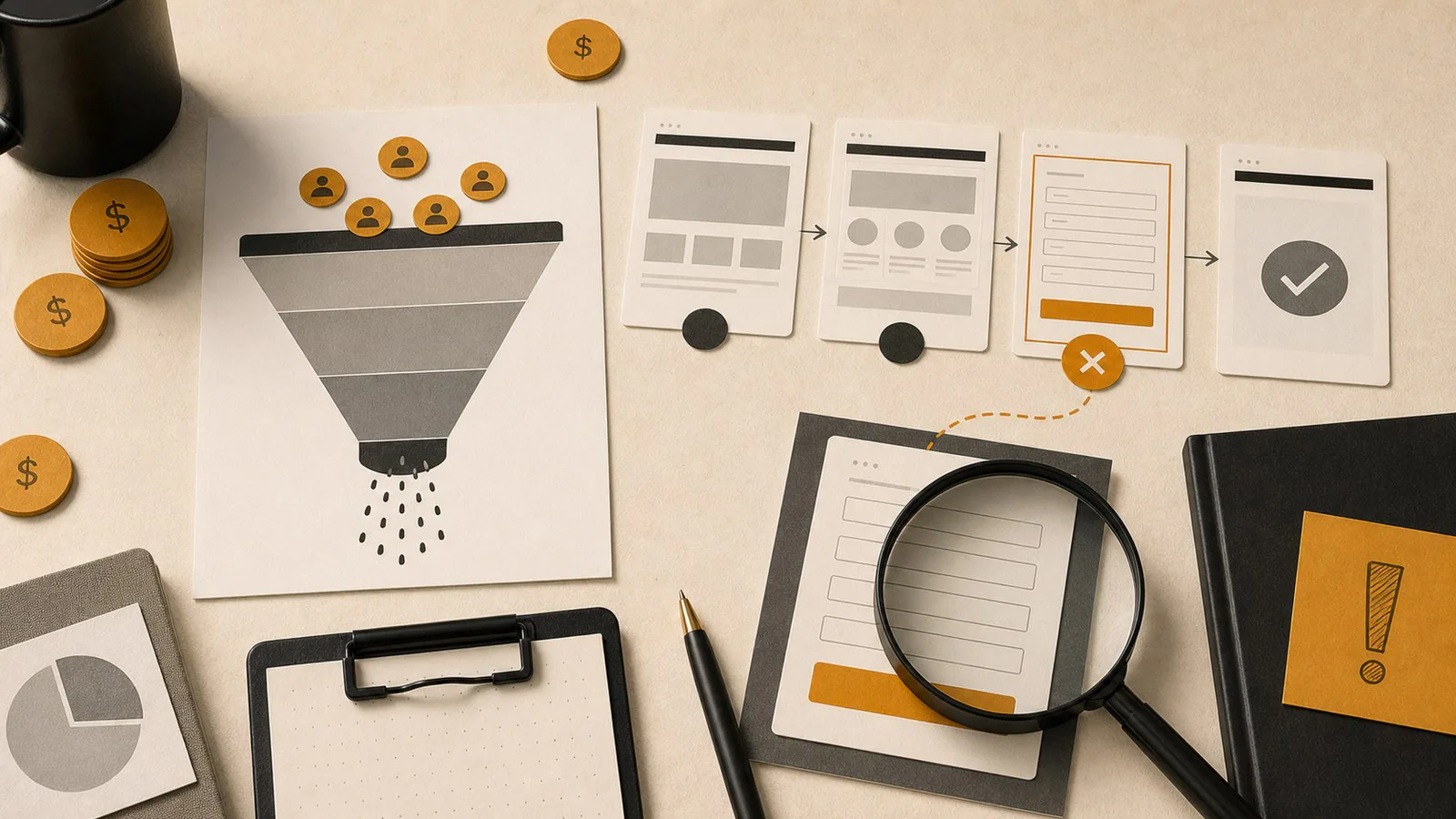
To explain a complex service on your website, lead with the buyer's problem and outcome, define who the service is for, break the work into understandable stages, show the evidence behind your claims, answer the risks that delay a decision, and give the visitor a next step that matches their readiness. Complexity should stay in the expertise, not in the buying journey.
A complex service is not a problem. Making the buyer decode it is.
Consulting firms, industrial suppliers, B-BBEE and enterprise-development specialists, logistics companies, environmental teams and technical contractors often sell work that genuinely needs explanation. The mistake is assuming the website must reproduce all that complexity before the visitor can understand the value.
A buyer normally arrives with a smaller set of questions:
- Is this relevant to my problem?
- Do you work with businesses like mine?
- What exactly will happen if I engage you?
- What proves you can do the work?
- What could go wrong?
- What should I do next?
If those answers are buried under internal terminology, a long company history or a list of everything the business has ever done, the website creates work for the buyer.
The better approach is to keep the expertise complex and make the decision path simple.
Start with the commercial problem, not your service vocabulary
A service page often opens with the name the company uses internally:
Integrated Enterprise Development Facilitation and Strategic Implementation Solutions
That may be technically accurate. It still asks the visitor to translate it.
The first screen should make the relevance obvious before introducing specialist language.
A useful structure is:
Problem → outcome → service name.
For example:
Problem: your supplier-development programme has targets, stakeholders and reporting requirements that are difficult to coordinate.
Outcome: you need one accountable process that keeps implementation, participant support and reporting aligned.
Service: enterprise-development programme management.
The specialist term now has context. The visitor does not need to know your vocabulary before understanding why the service exists.
Tell the visitor who the service is for
One of the fastest ways to make a complex service clearer is to narrow the audience.
Compare these two statements:
Broad: We deliver tailored business solutions to organisations across industries.
Specific: We help transformation teams and enterprise-development managers structure and run supplier-development programmes that need clear implementation, participant support and reporting.
The second statement excludes some people. That is useful.
A website should not make every visitor feel vaguely included. It should help the right visitor recognise fit quickly.
Useful fit signals can include:
- industries served;
- company size or operational complexity;
- geography;
- procurement requirements;
- project type;
- minimum scope;
- the internal person who normally owns the decision.
If a visitor can identify themselves, the rest of the page becomes easier to interpret.
Break the service into decisions, not departments
Many websites organise information according to the company’s internal structure.
The buyer does not necessarily care which department owns each activity. They care about what happens next.
A complex service usually becomes easier to understand when it is broken into a sequence:
- diagnose the current situation;
- define the scope and desired outcome;
- design the approach;
- implement the work;
- verify, report or hand over the result.
The exact stages will differ by industry. The principle does not.
A process gives the buyer a mental model. It answers a hidden question: what will working with you feel like?
That matters because uncertainty creates perceived risk.
Separate capability from proof
Claims and evidence are not the same thing.
These are claims:
- experienced team;
- high-quality service;
- reliable delivery;
- customer focused;
- industry leading;
- innovative solutions.
A buyer cannot inspect any of them.
Evidence is different:
- a relevant completed project;
- a named client where permission exists;
- a case study;
- a measurable operational result;
- a certification or accreditation;
- a photograph of the actual work;
- a documented process;
- a testimonial with enough context to be useful;
- years of experience tied to a specific capability;
- a team member’s relevant qualification;
- a live tool, report or example the buyer can inspect.
The page should place proof near the claim it supports.
If you say the business understands industrial waste compliance, show the experience, process, credentials or project evidence that makes the statement believable.
Do not make the buyer reach the footer before seeing a reason to trust you.
Use the “claim → evidence → implication” test
A simple editing framework can expose weak service-page copy.
For every major claim, ask three questions:
| Layer | Question | Example |
|---|---|---|
| Claim | What are we saying? | We manage complex multi-site projects. |
| Evidence | Why should the buyer believe it? | Three completed projects across 12 operating sites, with named scope and photographs. |
| Implication | Why does that matter to this buyer? | Your team gets one delivery structure across multiple locations instead of coordinating separate suppliers. |
The implication is often the missing layer.
Businesses tend to know their own evidence. They forget to translate that evidence into a reason the buyer should care.
Answer the objections that delay the enquiry
A complex service is often a higher-consideration purchase. The visitor may not enquire the first time they visit.
That means the website should reduce uncertainty before asking for contact details.
Common questions include:
- How long does the process take?
- What information do you need from us?
- Do you work nationally or only in one province?
- Is this once-off or ongoing?
- Who will manage the project?
- What happens after implementation?
- Which systems or suppliers do we need to provide?
- Can the work fit our procurement process?
- What is included in the quoted scope?
- What would make us a poor fit?
You do not need to publish every operational detail. You do need to remove avoidable ambiguity.
A useful website makes the sales conversation better because the buyer arrives with a more accurate understanding of the work.
Do not make “Contact us” carry the whole conversion journey
Not every visitor is ready to request a quote.
For a considered service, useful next steps can include:
- view a relevant case study;
- see the working method;
- compare package or scope information;
- run a diagnostic;
- download a checklist;
- request a discovery call;
- ask a specific technical question;
- start a project enquiry.
The CTA should match the amount of trust the page has earned.
A visitor who has only seen a headline and three generic service cards may not be ready to “Get a quote”. A visitor who has seen the problem, process, proof, fit and scope has far more context for that decision.
Give each page one commercial job
A common failure on complex-service websites is trying to make every page explain everything.
Instead, assign a job to each page.
Homepage: establish relevance, category, priority offers and proof.
Service page: explain one problem, one buyer, one service and the evidence behind it.
Case study: prove the business can handle a real version of the problem.
About page: explain the people, operating principles and credibility behind delivery.
Working-method page: reduce process uncertainty.
Pricing or scope page: reduce commercial ambiguity where appropriate.
Contact page: make the next step easy.
The site becomes clearer when every page does less, better.
A practical service-page structure
For many South African B2B and specialist service businesses, this sequence is a useful starting point:
1. Relevance
State the problem and outcome in language the buyer uses.
2. Fit
Explain who the service is designed for and where it applies.
3. Scope
Show what is included without turning the page into a specification document.
4. Process
Give the buyer a simple model of how the work progresses.
5. Proof
Show relevant evidence close to the claims it supports.
6. Risk reduction
Answer the questions that could delay a decision.
7. Next step
Offer an action appropriate to the buyer’s readiness.
That structure is not a template that every business should copy exactly. It is a decision sequence.
What search and AI systems change
The same clarity that helps a buyer can also make the public business easier for machines to interpret.
A page that clearly states the business, service, location, audience, process and evidence creates a stronger public explanation than a page built from slogans.
Technical work still matters: crawl access, metadata, internal links, structured data and performance all affect how public information can be discovered and interpreted.
But technical optimisation cannot rescue an unclear proposition.
If the page does not clearly explain what the business does, adding more machine-readable markup does not create the missing business evidence.
That is why IDJoy treats visibility as an extension of business clarity rather than a separate layer of magic added after launch.
The 10-minute clarity test
Open one important service page and answer these questions without using information that only exists in your head:
- Can a new visitor identify the problem this service solves?
- Can they identify who the service is for?
- Can they explain the outcome in one sentence?
- Can they see what is included?
- Can they understand the delivery process?
- Can they find evidence supporting the main claims?
- Can they tell where the business operates?
- Can they identify an important limitation or fit condition?
- Can they see a sensible next step?
- Could someone outside the company summarise the page accurately after one read?
Every “no” is a possible clarity gap.
Do not redesign the page yet. Diagnose the gaps first.
The strategic point
The best website for a complex service does not remove the sophistication from the work.
It removes unnecessary complexity from the decision.
That requires more than a visually impressive page. It requires decisions about what the company is selling, who needs it, what the buyer must understand, which proof matters and what should happen next.
That is the work IDJoy puts before visual design in its working method.
If your current website contains the right information but still makes the buyer work too hard to understand it, start with the structure. A clearer design should be the result of clearer thinking, not a substitute for it.