
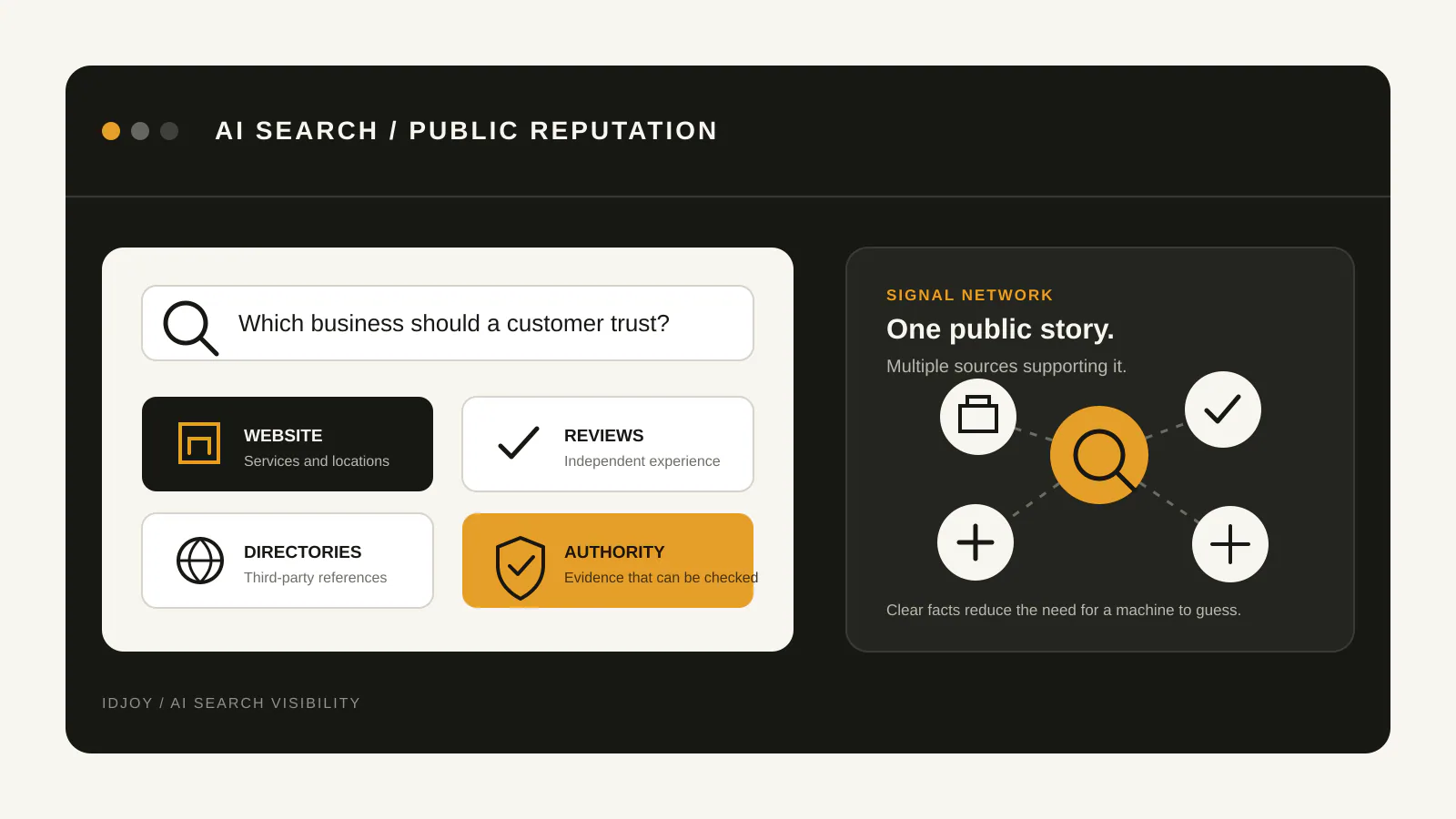
AI search engines can assess a business using its website, reviews, public profiles, directory listings and third-party mentions before deciding whether to include it in an answer. Businesses improve their chances by publishing clear service and location information, correcting inconsistent details, linking real expertise to named people, earning genuine reviews and building credible independent references.
A potential customer may learn about your business without opening your website.
They can ask ChatGPT, Gemini, Perplexity or Google a question such as:
Which risk management consultants serve industrial companies in Gauteng?
The system can search several sources, compare the available businesses and return a short answer. Your company could be recommended, described inaccurately or omitted completely.
That is the practical change business owners need to understand.
Traditional search usually gives the customer links to investigate. AI search can perform part of that investigation before the customer clicks. ChatGPT Search provides answers supported by web sources, while Google’s AI features may perform several related searches before constructing a response.
The machine is not producing an infallible verdict. AI answers can still contain errors, miss important context or rely on weak sources. Important claims should still be checked.
However, the answer can shape a customer’s first impression.
The useful question is not, “How do we manipulate AI?”
It is:
What public evidence are we giving AI systems to work with?
From ten links to one compressed answer
A customer using conventional search might open your website, read your Google reviews, visit your LinkedIn page and compare two competitors.
An AI assistant can compress much of that research into a few paragraphs.
It may encounter:
- Your website and service pages
- Google Business Profile information
- Customer reviews
- Business directories
- News coverage
- Founder and employee profiles
- Industry memberships
- Case studies
- Old press releases
- Forum discussions
- Information published by your partners
The final answer is shaped by what the system can find, understand and support.
This creates a difficult problem for businesses with fragmented public information.
Your homepage may say you serve all of South Africa. Your Google profile may only mention Pretoria. An old company profile may promote services you stopped offering three years ago. Your founder may have ten years of experience, but no public biography connects that experience to the company.
A person might investigate further and resolve those contradictions.
An AI system may not. It can produce an incomplete answer from the clearest evidence available.
Four numbers worth paying attention to
NP Digital analysed 82 possible factors associated with ChatGPT brand recommendations. Its published findings reported relevance, brand mentions, reviews and authority as the four strongest observed factors.
How closely the business or product matched the question being asked.
How often the brand appeared in discussions and references across the web.
Adobe found that US retail visits referred by AI converted 31% more often than other traffic during the 2025 holiday season.
Adobe measured a 693.4% year-on-year increase in generative-AI referrals to US retail sites during the same period.
The NP Digital scores are observed correlations from its study. They are not official OpenAI ranking weights and should not be treated as a fixed formula.
The Adobe figures come from US retail data. They do not predict the performance of every South African service business. They do support a useful conclusion: some AI-referred visitors arrive after completing more research than an ordinary browser.
The opportunity is not simply more traffic. It is the chance to be introduced while a customer is comparing options.
AI systems evaluate the source, not only the sentence
Perplexity describes itself as an answer engine that searches the web, identifies trusted sources and builds responses with citations that readers can verify.
This reveals a broader issue: the identity and track record of a source affect how its information is interpreted.
Consider two statements:
Our team provides the best occupational health services.
And:
Dr N. Mokoena, an occupational medical practitioner with 12 years of experience, leads the company’s occupational health assessments. The process, qualifications and assessment scope are documented on the service page.
The first is a marketing claim.
The second gives a system identifiable facts to evaluate.
Authority is not created by using impressive words.
It grows when a business connects specific claims to named people, real qualifications, completed work, customer evidence and credible independent sources.
Your business needs one clear public story
AI visibility does not belong to one department.
Your website, advertisements, social profiles, media coverage, reviews and directory listings all contribute to the public description of the company.
When each channel tells a different story, the system may struggle to determine:
- What the company actually sells
- Which customers it serves
- Where it operates
- Whether it is still active
- Who is responsible for the work
- What evidence supports its claims
- Whether the company is relevant to the customer’s question
The solution is not to repeat one slogan everywhere.
It is to make the underlying facts consistent.
Your company name, main service category, operating areas, key people, contact details and core offer should agree across the public web.
A clear story is easier for customers to understand and easier for machines to verify.
Publishing more content can make the problem worse
The fastest reaction to a visibility problem is often: “We need more blogs.”
That is not always true.
Twenty weak articles do not compensate for a vague service page, missing proof or contradictory company information. More content can amplify the wrong story.
Google’s May 2026 guidance for generative AI in Search emphasises valuable, unique and non-commodity content. It also states that established SEO fundamentals remain relevant. There is no special shortcut that replaces clear, useful information.
Before publishing another article, ask:
- Does this answer a real customer question?
- Does it contain information specific to our experience?
- Is a qualified person responsible for the advice?
- Can we support the claims?
- Does it reinforce the services we genuinely want to sell?
- Is it more useful than the pages already covering the topic?
A smaller body of strong, connected evidence is more useful than a large collection of interchangeable posts.
Seven signals that make a business easier to understand
State what you do in the terms a customer would use. "Commercial fire-equipment servicing for factories in Gauteng" is more useful than "integrated solutions."
Use the same trading name, location, phone number, service category and website address across your main profiles.
Publish accurate author names, biographies, qualifications and relevant experience. Do not invent credentials or manufacture thought leadership.
Use case studies, project summaries, before-and-after examples, verified outcomes and detailed testimonials.
Ask customers to describe the service received, the problem solved and the location involved. Never buy or script reviews.
Earn mentions from industry bodies, partners, publications, customers and directories that make sense for your market.
Keep important information in readable HTML, connect related pages with internal links and allow the relevant search crawlers.
OpenAI states that allowing OAI-SearchBot is important for inclusion in ChatGPT Search, while making clear that no business can guarantee top placement. Google similarly requires pages to be eligible for normal Search before they can appear as supporting links in its AI features.
Your website can influence the advertisements you pay for
This issue is not limited to unpaid AI recommendations.
Google Ads states that AI Max can use text from existing advertisements, landing-page copy and supplied assets to create customised ad copy. Final URL expansion can also send a user to a different page on the advertiser’s domain when the system predicts that page is more relevant to the search.
That means your website is no longer only the place an advertisement sends people.
It can become source material used to interpret the offer and create parts of the campaign.
A vague website can affect:
- Which searches the campaign considers relevant
- Which landing page receives the visitor
- Which headline is generated
- How the offer is described
- Whether the message matches the customer’s intention
A clear website improves more than presentation. It gives automated systems better inputs.
Run a 15-minute AI reputation check
Open several AI search tools and test your business using the questions below.
Do not only search for the company by name. A customer who already knows your name is not the same as a customer discovering providers in your category.
Test one: recognition
What does [business name] do?
Check whether the services, location and target customers are correct.
Test two: discovery
Recommend companies that provide [service] in [area].
Check whether your business appears when the customer does not mention it by name.
Test three: comparison
Compare [business name] with other providers of [service].
Look for missing strengths, incorrect information and unsupported assumptions.
Test four: evidence
Which sources support this description of [business name]?
Inspect which websites, reviews and profiles are influencing the answer.
Test five: recency
What are the latest services and contact details for [business name]?
Look for old addresses, retired offers, former employees and outdated descriptions.
Record the results:
| Check | Accurate | Incomplete | Incorrect | Missing evidence |
|---|---|---|---|---|
| Services | ||||
| Location | ||||
| Expertise | ||||
| Customer proof | ||||
| Contact details | ||||
| Competitive position |
The aim is not to force every platform to produce identical wording.
The aim is to identify repeated gaps in the evidence available about your business.
Build another credible reference through Findable ZA
IDJOY is developing Findable ZA, a controlled visibility index for South African service businesses.
The founding release starts with selected service categories in Pretoria, Centurion and the wider Tshwane area. Businesses can submit their services, operating areas, website, public profiles and customer-facing evidence for manual review.
An approved public profile is intended to help customers understand:
- What the business does
- Where it operates
- Which services it provides
- What evidence customers can inspect
- How to contact it
- Which website or public profile belongs to it
An approved listing may provide a relevant third-party reference and a link to the business’s website where appropriate.
It is not an instant backlink scheme. Submission does not guarantee publication, ranking, leads or recommendation by any AI platform. Category pages remain outside search indexes during the founding phase until enough approved businesses are available to create a useful comparison.
Submit your business for the founding review
The same form can be used to request an IDJOY visibility assessment covering your website, service pages, internal links, trust evidence and search visibility.
Submit a businessWhat to repair first
Do not try to fix every channel at once.
First: correct the facts
Update the company name, services, locations, team information and contact details wherever they are wrong.
Second: strengthen the service pages
Give each important service a clear explanation, suitable customer, operating area, process and enquiry route.
Third: publish proof
Document completed work, customer outcomes, qualifications and experience.
Fourth: improve independent evidence
Request genuine reviews. Join relevant professional bodies. Build useful partnerships. Contribute insight to credible publications and controlled directories.
Fifth: recheck the answers
Repeat the discovery and comparison prompts after material changes. AI outputs vary, so look for patterns rather than treating one answer as a permanent ranking.
See what AI says before a customer makes the decision
Your business already has a public record.
The question is whether that record is clear, current and supported.
IDJOY can assess how your website, service pages, business profiles, reviews and third-party references work together. The outcome is not a fabricated AI score. It is a prioritised explanation of what is missing, what is contradictory and which improvements are most likely to strengthen customer trust and online visibility.
Submit your business and request the visibility assessment.
A machine should not have to guess what your business does.
Neither should your customer.