
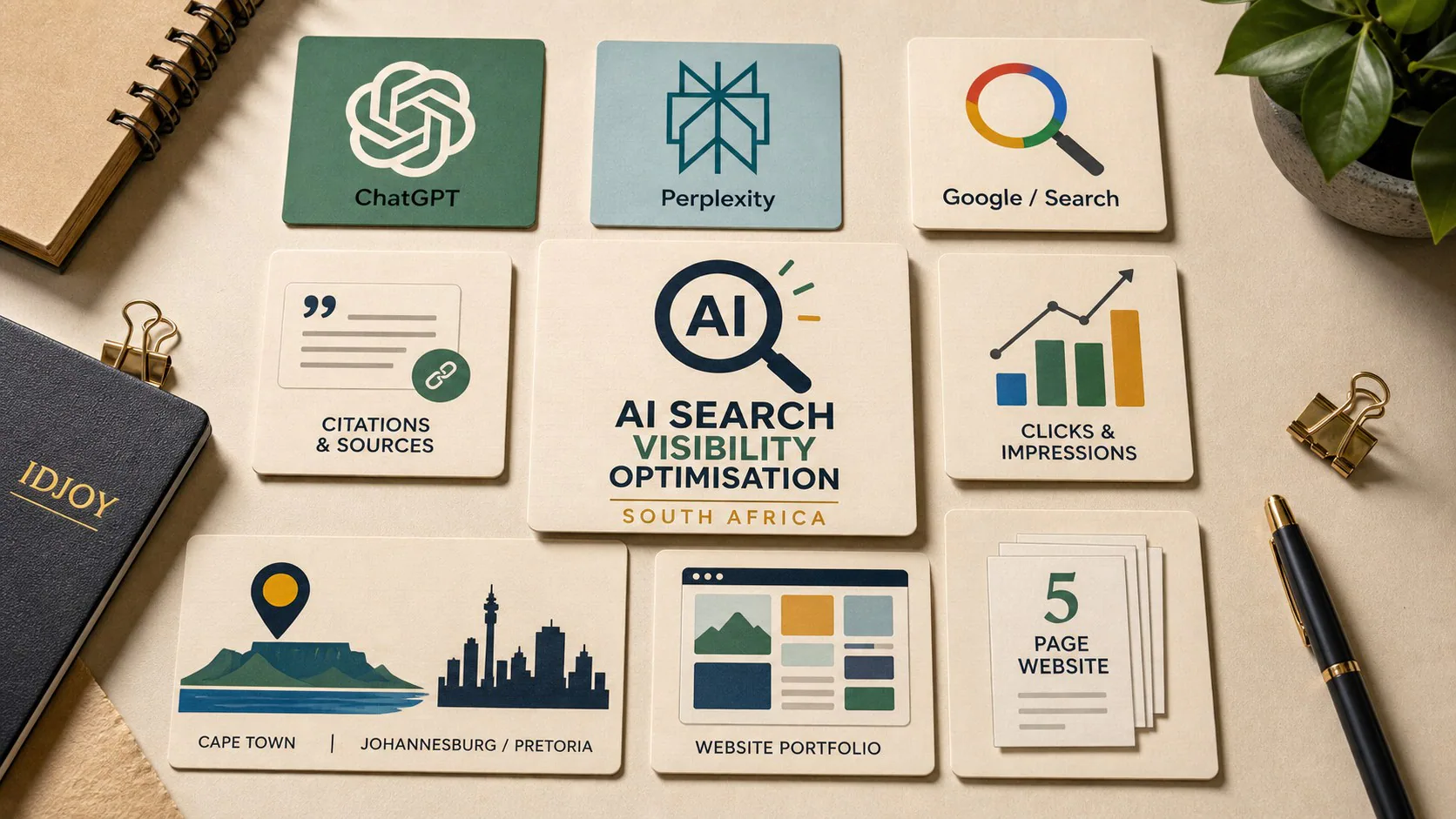
Improve AI search visibility by making important pages crawlable, publishing clear answers backed by first-hand evidence, keeping business facts consistent and testing a fixed set of buyer prompts across engines. Record mentions, citations, accuracy, referral visits and enquiries. No file, schema type or agency can guarantee that an AI system will recommend your business.
A South African business can rank on Google and still disappear from an AI answer.
It can also receive a ChatGPT mention that sends no qualified traffic, a Perplexity citation that repeats an old service, or a Gemini answer that names the company but gets the location wrong.
AI visibility has value when the right buyer finds an accurate description, reaches a useful page and takes a commercial next step.
That requires more than adding “GEO” to an SEO package.
What AI search visibility means
AI search visibility measures whether systems such as ChatGPT, Google AI features, Gemini and Perplexity can discover, understand, cite and recommend a business for relevant questions.
The work has four layers:
- Access: Can the engine or its search partner reach the page?
- Understanding: Does the page explain the service, location, audience and evidence clearly?
- Selection: Does the engine choose the business or its page when answering the question?
- Business value: Does the visibility produce useful visits, enquiries or assisted decisions?
Many audits stop at layer three. IDJOY measures the fourth because a mention without commercial value can distract a team from stronger work.
Start with a 20-prompt baseline
Do not rewrite the website from one flattering or disappointing answer.
Build a fixed prompt set around the questions buyers ask before choosing a provider.
Use five groups with four prompts each.
Category prompts
These test broad discovery.
- Which web design companies serve small businesses in Pretoria?
- Which process safety consultants operate in South Africa?
- Which firms offer corporate landscaping in Mpumalanga?
- Which South African agencies help businesses improve AI search visibility?
Problem prompts
These start with a business need.
- Who can redesign a service website that receives traffic but few enquiries?
- Which company can help a factory prepare for a HAZOP study?
- Who can build a professional website for a company without an internal marketing team?
- Which provider can help a South African business become easier to find in ChatGPT and Perplexity?
Comparison prompts
These force an engine to evaluate choices.
- Compare three Pretoria web designers for a five-page business website.
- Compare a freelancer, small studio and agency for a South African SME website.
- Which South African AI visibility services publish their method and limitations?
- Compare once-off website pricing with monthly website packages in South Africa.
Evidence prompts
These test whether public proof exists.
- Which South African web designers publish detailed pricing and ownership terms?
- Which agencies show case studies that explain the business problem and result?
- Which local providers explain how they measure ChatGPT and Perplexity recommendations?
- Which firms publish original South African research in their service category?
Branded accuracy prompts
These test entity understanding after the engine receives the name.
- What services does IDJOY provide?
- Where is IDJOY based?
- Does IDJOY publish web design prices?
- What evidence supports IDJOY’s AI search visibility service?
Discovery and branded prompts answer different questions. Keep them separate in the report.
Record the test conditions
Save each prompt with:
| Field | What to record |
|---|---|
| Date and time | Exact run time |
| Engine | ChatGPT, Gemini, Perplexity or Google AI feature |
| Product or mode | Search, deep research, AI Mode or another named mode |
| Account state | Logged in or logged out |
| Location context | Stated city, province or country |
| Exact prompt | Unedited wording |
| Business mentioned | Yes or no |
| Website cited | Yes or no |
| Other source cited | Directory, news, social, review or competitor page |
| Accuracy | Correct, incomplete or wrong |
| Sentiment | Positive, neutral or negative |
| Competitors | Names and positions |
| Next action | Technical, content, profile or evidence task |
Run prompts in clean chats. Previous conversation context changes answers.
A baseline does not produce a universal ranking. It creates a repeatable observation under stated conditions.
Check whether engines can access the site
Content cannot earn a citation when the system cannot reach it.
Google says its generative AI features use the core Search index and ranking systems. The usual Search requirements remain relevant. Pages must be crawlable, indexable and eligible to show snippets.
Google does not require an AI-specific text file or special schema type for AI Overviews or AI Mode.
ChatGPT
OpenAI tells publishers not to block OAI-SearchBot when they want pages included in ChatGPT search summaries and snippets.
OAI-SearchBot concerns search discovery. GPTBot concerns potential model training. Treat them as separate controls.
Perplexity
Perplexity documents PerplexityBot for search discovery and linking. It recommends allowing that crawler and its published IP ranges.
Perplexity also documents Perplexity-User, a user-request fetcher that can visit a page while answering a question and generally ignores robots.txt because the user initiated the request.
What to inspect
Check:
robots.txtrules.noindextags.- Canonical URLs.
- Firewall and bot-protection rules.
- Pages that require JavaScript before the main answer appears.
- Redirect loops.
- Duplicate query-string and clean URLs.
- XML sitemap coverage.
- Server logs where available.
Crawler access proves only access. It does not prove selection or recommendation.
Build one strong page for each search intent
Google’s July 2026 generative AI guidance warns against creating separate pages for every prompt variation. A high page count does not create quality.
The same principle applies beyond Google.
Group close phrases into one definitive page.
For example, these queries belong to one pricing pillar:
- web design prices South Africa;
- web design South Africa pricing;
- web design rates South Africa;
- web design cost South Africa;
- website design costs South Africa.
Publishing five thin versions splits links, internal authority, updates and reader attention.
The strong page should answer the broad question, then separate real sub-decisions such as first-year costs, quote comparison and freelancer-versus-agency models into distinct supporting pages.
Publish non-commodity evidence
AI systems can summarise generic advice from thousands of pages. A business earns selection when it contributes information that competing pages cannot replace.
Useful original evidence includes:
- A real project decision and why it changed.
- An anonymised scope document.
- A current price or starting range with exclusions.
- A test method and raw prompt list.
- A before-and-after information structure.
- An industry checklist based on field work.
- A client-approved result with dates and limits.
- A documented failure and the correction.
- A local regulatory or operational explanation.
Do not manufacture statistics to look authoritative. A small honest sample beats an invented percentage.
IDJOY uses client work, website audits, public pricing, technical checks and repeatable prompt tests as evidence sources.
Make the business entity consistent
AI answers often combine information from the company website, directories, social profiles, reviews and third-party articles.
Conflicting facts create inaccurate answers.
Review:
- Legal and trading name.
- Primary domain.
- Phone number.
- Address or service area.
- Services.
- Industries served.
- Founder and team names.
- Opening hours.
- Social profile links.
- Pricing claims.
- Old brand names and domains.
Correct the sources that engines already cite. Publishing another blog post cannot override a stronger directory that still shows the wrong location.
Strengthen commercial pages, not only blog posts
A useful article can earn a citation and still fail to produce a lead.
The linked service page must answer:
- Who the service is for.
- What problem it solves.
- What is included.
- What is excluded.
- How the work happens.
- What evidence supports the offer.
- What it costs or how pricing works.
- What the visitor should do next.
AI visibility work should improve the page a buyer reaches after the citation.
IDJOY combines article publishing with service-page implementation because the hand-off between SEO advice and website changes often kills progress.
Build independent corroboration
A company cannot establish every claim through its own website.
Third-party sources can confirm:
- Business existence.
- Location.
- Reviews.
- Professional memberships.
- Industry participation.
- Published expertise.
- Partnerships.
- Project work.
Focus on legitimate sources that serve the audience. Do not buy hundreds of low-quality directory links or fake mentions.
A useful external source should help a person verify the business even when no AI system existed.
Use structure that helps readers first
Clear headings, direct answers, tables, definitions and descriptive links help people scan complex pages. They also make sections easier for retrieval systems to interpret.
Do not turn every paragraph into a rigid “AI chunk.” Google’s official guidance says special chunking and AI text files are unnecessary for Google Search.
Use structure because the subject needs it:
- Put the direct answer near the top.
- Give tables clear column names.
- Keep one main question per section.
- Link claims to primary sources.
- Name dates and locations.
- Use descriptive internal links.
- Keep important content in crawlable HTML.
The page should still read like a person wrote it for another person.
Measure with the new Google report where available
On 3 June 2026, Google announced dedicated Generative AI performance reports in Search Console for a subset of websites.
The reports can show impressions, pages, countries, devices and dates for generative AI features in Search and Discover. Availability remains limited during the rollout.
Use the report when the property has access. Do not claim every site can see it yet.
Combine it with:
- Standard Search Console performance.
- ChatGPT referral traffic using
utm_source=chatgpt.com. - Other identifiable AI referrers.
- Server-log crawler activity.
- Form submissions and call tracking.
- Lead-source questions.
- Manual prompt observations.
No single tool captures the full journey.
Rerun after a fixed interval
Choose a testing interval that matches the pace of change.
Monthly testing works for most small businesses. A large publisher or fast-moving product may test more often.
Use the same core prompts for at least three cycles. Add new prompts in a separate group so the baseline remains comparable.
Record:
- Mention share.
- Citation share.
- Accuracy.
- Competitor inclusion.
- Pages cited.
- Referral sessions.
- Engaged sessions.
- Qualified enquiries.
- Assisted conversions.
- Test volatility.
A result that appears once and disappears twice is unstable. Report it that way.
What does not improve AI visibility on its own
Adding llms.txt
Google states that it does not use llms.txt or other special AI files for Search. Other systems may publish an llms.txt documentation index without using a site’s file as a ranking signal.
Treat it as an optional documentation convenience, not an AI visibility strategy.
Adding schema without matching page content
Structured data can clarify content. It cannot create services, proof, prices or locations that the visible page does not explain.
Publishing hundreds of AI articles
Scaled generic content creates maintenance and duplication problems. It can also weaken the pages that deserve attention.
Repeating “best” claims
A self-declared leadership claim carries little weight without comparison criteria and public evidence.
Buying AI recommendations
No legitimate provider can purchase a guaranteed organic recommendation from ChatGPT, Gemini, Perplexity or Google AI features.
A 90-day South African AI visibility plan
Days 1 to 30: baseline and access
- Run the 20-prompt test.
- Check crawlers, indexing, canonicals and sitemap coverage.
- Map the sources engines cite.
- Correct inconsistent business facts.
- Choose the three commercial prompts with the largest gap.
Days 31 to 60: improve the source pages
- Strengthen the main service pages.
- Consolidate duplicate content.
- Publish one or two evidence-led supporting articles.
- Add case studies, scope examples or clear pricing where possible.
- Improve internal links from articles to services and proof.
Days 61 to 90: retest and connect to outcomes
- Rerun the fixed prompts.
- Compare mentions, citations and accuracy.
- Review Google and AI referral traffic.
- Inspect which pages attract engaged visits.
- Record qualified enquiries and assisted decisions.
- Choose the next improvement from the evidence.
How IDJOY approaches AI visibility
IDJOY works with South African service businesses that need the website, content and measurement connected.
The process includes:
- A fixed prompt baseline.
- Technical access checks.
- Service-page improvements.
- Evidence-led content.
- Internal linking.
- Business-fact consistency.
- Monthly retesting.
- Reports that separate observations from analytics.
IDJOY does not guarantee recommendations, first positions or a fixed result date.
The service fits businesses that can contribute real experience and want a method they can inspect. It does not fit companies looking for a secret submission form or a volume-content shortcut.
Review the AI search visibility service for the current scope and pricing.
Then use the AI recommendation measurement guide to build the scorecard before you pay anyone to improve it.