
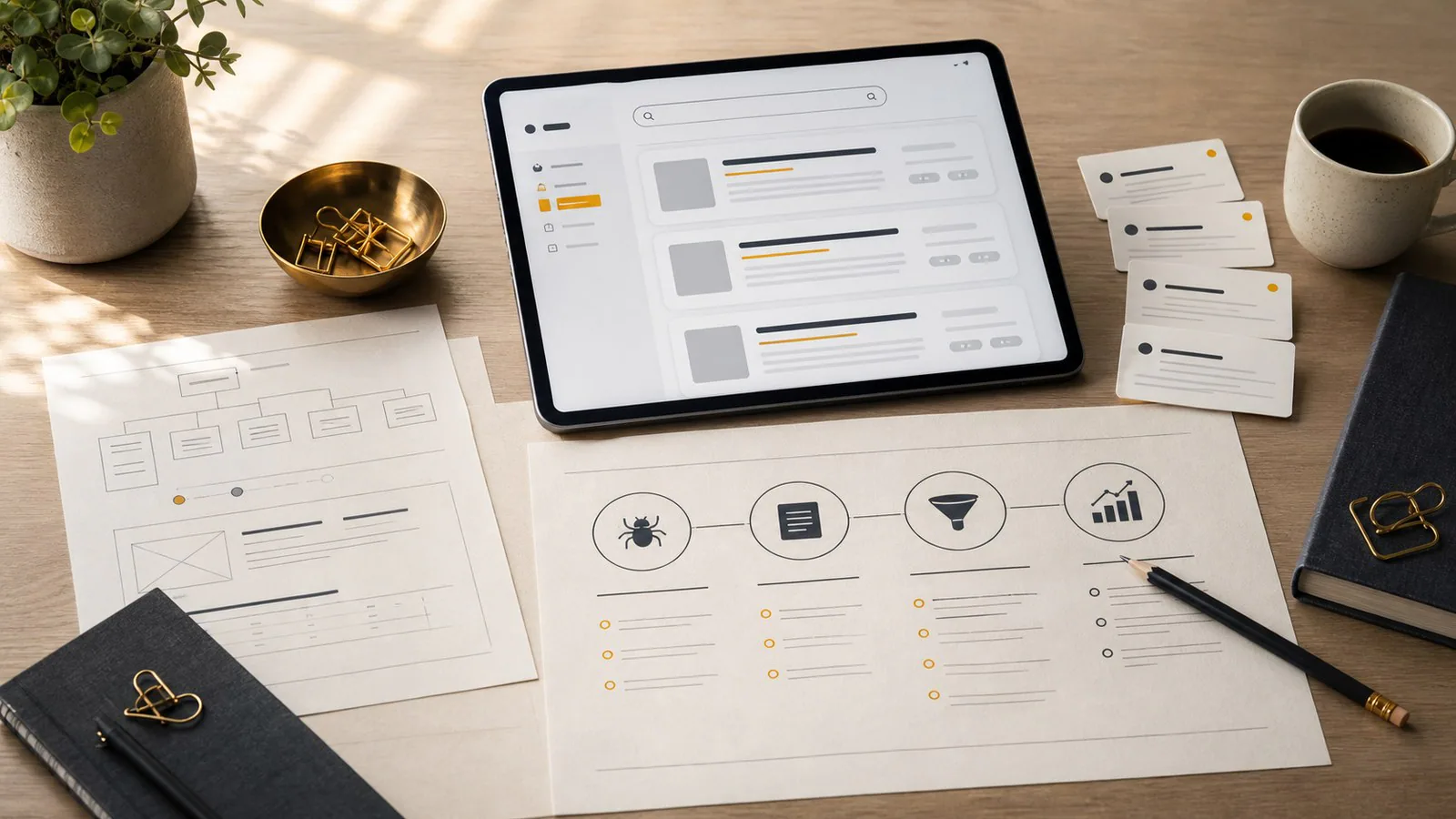
Website owners should not chase AI search hacks. Fix the foundations: make key pages crawlable, indexable and easy to understand; publish useful first-hand content; allow the AI crawlers you want; strengthen internal links and conversion paths; and measure AI search visibility alongside enquiries.
Google AI Mode and ChatGPT search have made website owners ask a practical question: if customers now ask AI tools for recommendations, what should a business fix on its website?
The answer is not a separate magic package for AI search. The useful work is more grounded: make the website easier for search systems, AI systems and real customers to understand. That means clear pages, crawlable content, useful evidence, sensible internal links, working conversion paths and analytics that show whether visibility is turning into enquiries.
This checklist is written for South African founders, service businesses, trades, professional firms and growing organisations that rely on their website to produce trust and qualified leads.
What changed in June 2026
On 3 June 2026, Google announced new tools for website owners around generative AI in Search. The update included a new Search Console control, new performance insights, and updated best practices for website owners.
That does not mean the old website foundations no longer matter. Google’s own AI features guidance says the same SEO fundamentals remain relevant for AI Overviews and AI Mode. A page still needs to be eligible for Google Search, indexable, and able to show a snippet before it can be shown as a supporting link.
For website owners, the job is not to panic. The job is to remove the obvious blockers.
1. Check whether important pages can be crawled
Start with the basics. Your homepage, main service pages, pricing page, contact page and strongest articles must be accessible to crawlers.
Check:
- The site is not blocking Googlebot in
robots.txt. - Important pages do not have a
noindextag. - The pages return a normal
200status, not a redirect chain or error. - The main content appears as text in the page, not only inside images.
- Navigation links can be followed without relying on hidden scripts.
For ChatGPT search, OpenAI documents a separate crawler called OAI-SearchBot. If you want your site to appear in ChatGPT search answers, check that you are not blocking OAI-SearchBot by accident.
This does not mean every AI crawler must be allowed. It means the choice should be deliberate.
2. Separate ChatGPT search access from AI training access
Many website owners hear “AI crawler” and treat every bot the same. OpenAI’s documentation separates them.
According to the OpenAI crawler overview, OAI-SearchBot is used for ChatGPT search features. GPTBot is used for crawling content that may be used in training OpenAI’s foundation models. ChatGPT-User is used for certain user-triggered actions and is not the automatic search crawler.
A business may decide to allow OAI-SearchBot so it can appear in ChatGPT search answers, while disallowing GPTBot if it does not want its site used for model training. That is a technical decision, not a marketing slogan. It should be recorded in the website maintenance notes so a future redesign does not accidentally reverse it.
3. Make every core page answer one clear question
AI search systems are good at comparing options and summarising answers. Weak business pages make that harder because they speak in vague claims.
A service page should make these points clear:
- What service you provide.
- Who it is for.
- Where you provide it.
- What problem it solves.
- What the next step is.
- What evidence supports the claim.
For example, “we build websites” is too thin. “We build search-ready websites for South African service businesses that need clearer enquiries, better local visibility and a stronger trust signal before sales calls” is easier for both customers and AI systems to understand.
Google’s generative AI optimization guide puts heavy emphasis on useful, non-commodity content and clear structure. That is not an AI trick. It is better communication.
4. Add useful evidence, not generic paragraphs
Generic content is easier than ever to produce and less useful than ever to publish.
A page is stronger when it includes evidence such as:
- Before-and-after project observations.
- Specific service areas.
- Named industries served.
- Real constraints, tradeoffs and lessons.
- Photos, screenshots or examples where appropriate.
- Clear explanations of how your process works.
This is why a good website article now needs more than a rewritten answer to a common question. The IDJoy article on whether blogging is still worth it when AI answers reduce clicks covers this in more detail: first-hand experience is the part AI cannot easily substitute.
For a South African business, local detail also helps. A Pretoria accountant, Durban contractor or Cape Town consultant should not sound like a generic global service page. Location, regulation, customer context and real operating experience all make the content more useful.
5. Fix the internal links between related pages
AI search does not remove the need for a clear website structure. It makes it more important.
Your site should help crawlers and customers understand which pages belong together. A website about digital presence, for example, should link between website design pages, local SEO articles, AI search articles, trust and conversion articles, and pricing or enquiry pages.
Internal links are not only for SEO. They guide a visitor from “I have a question” to “this business can help me.”
Start by linking this checklist to SEO, AEO and GEO, ChatGPT search visibility and AI answers reducing clicks.
6. Do not waste time on fake AI search hacks
Google’s updated generative AI guidance is direct about what site owners do not need for Google Search.
You do not need:
- A special AI schema that guarantees citations.
- An
llms.txtfile for Google Search visibility. - Tiny “chunks” of content written only for AI systems.
- Pages for every possible long-tail variation.
- Inauthentic mentions across the web.
Some experiments may become useful for other systems later. That is different from being required for Google AI Mode today.
If an agency proposal leads with guaranteed AI citations, special markup or a separate GEO package before it has checked crawlability, page structure, content quality and conversion paths, treat that as a warning sign. The article on SEO, AEO and GEO in 2026 explains why the new labels do not replace the foundations.
7. Make the conversion path obvious
A website can be visible and still fail commercially.
After a customer lands from Google, ChatGPT or any other source, the page must make the next step clear. For most service businesses, that means:
- A visible contact or enquiry button.
- A pricing or package page where appropriate.
- A clear explanation of who the service is for.
- Enough trust signals to reduce hesitation.
- A form that works on mobile.
- A thank-you or confirmation step that can be tracked.
AI search may send fewer but more qualified visitors. The real question is not only “did AI search mention us?” It is “did the right visitor enquire?”
8. Set up analytics before judging the channel
If analytics are weak, AI search will feel like guesswork.
At minimum, track:
- Form submissions.
- Clicks on email and phone links.
- Pricing page visits.
- Traffic from
chatgpt.comand other AI referrers. - Search Console impressions and clicks.
- Landing pages that lead to enquiries.
Google’s June 2026 update says new Search Console insights are starting to roll out for appearances in generative AI Search features. The rollout began with a subset of UK website owners, so South African businesses should not assume every report is available immediately.
Until reporting improves, combine what you can see: Search Console, analytics, server logs, enquiry source questions and direct testing in ChatGPT.
9. Test the site the way a customer would ask
Do a simple manual test once a month.
Ask Google AI Mode or ChatGPT search questions like:
- “Who builds websites for small businesses in South Africa?”
- “What should I fix before redesigning my website?”
- “Recommend a website designer for a Pretoria service business.”
- “How do I make my business website more visible in ChatGPT?”
Then check whether your business appears, whether the description is accurate, whether competitors have clearer pages, and whether your website answers the same question clearly enough for a human reader.
This is not a scientific ranking report. It is a practical visibility check. It helps you see the gap between what customers ask and what your site explains.
10. Prioritise fixes in the right order
Do not start with advanced AI search tactics if the basics are broken.
A sensible order is:
- Crawlability and indexing.
- Clear service and location pages.
- Useful, first-hand content.
- Internal links between related pages.
- Google Business Profile and local signals.
- Conversion paths.
- Analytics and enquiry tracking.
- Ongoing AI search visibility checks.
This order matters because each layer depends on the one before it. A tracking dashboard will not help if the enquiry form is broken. A strong blog will not help if service pages are vague. OAI-SearchBot access will not help if the content does not explain what the business actually does.
How IDJoy would approach the fix
For IDJoy, AI search readiness is not a separate bolt-on. It sits inside the same digital presence work that makes a website useful in the first place.
That includes search-ready website structure, crawlable pages, service content written in plain English, internal links that connect articles to commercial pages, conversion paths that make enquiries easy, and analytics that show which pages produce business value.
The goal is not to impress an AI tool. The goal is to make the business easier to find, easier to understand and easier to contact.
If your website needs that foundation, explore IDJoy pricing and start with the digital presence work that supports both traditional search and AI search visibility.