
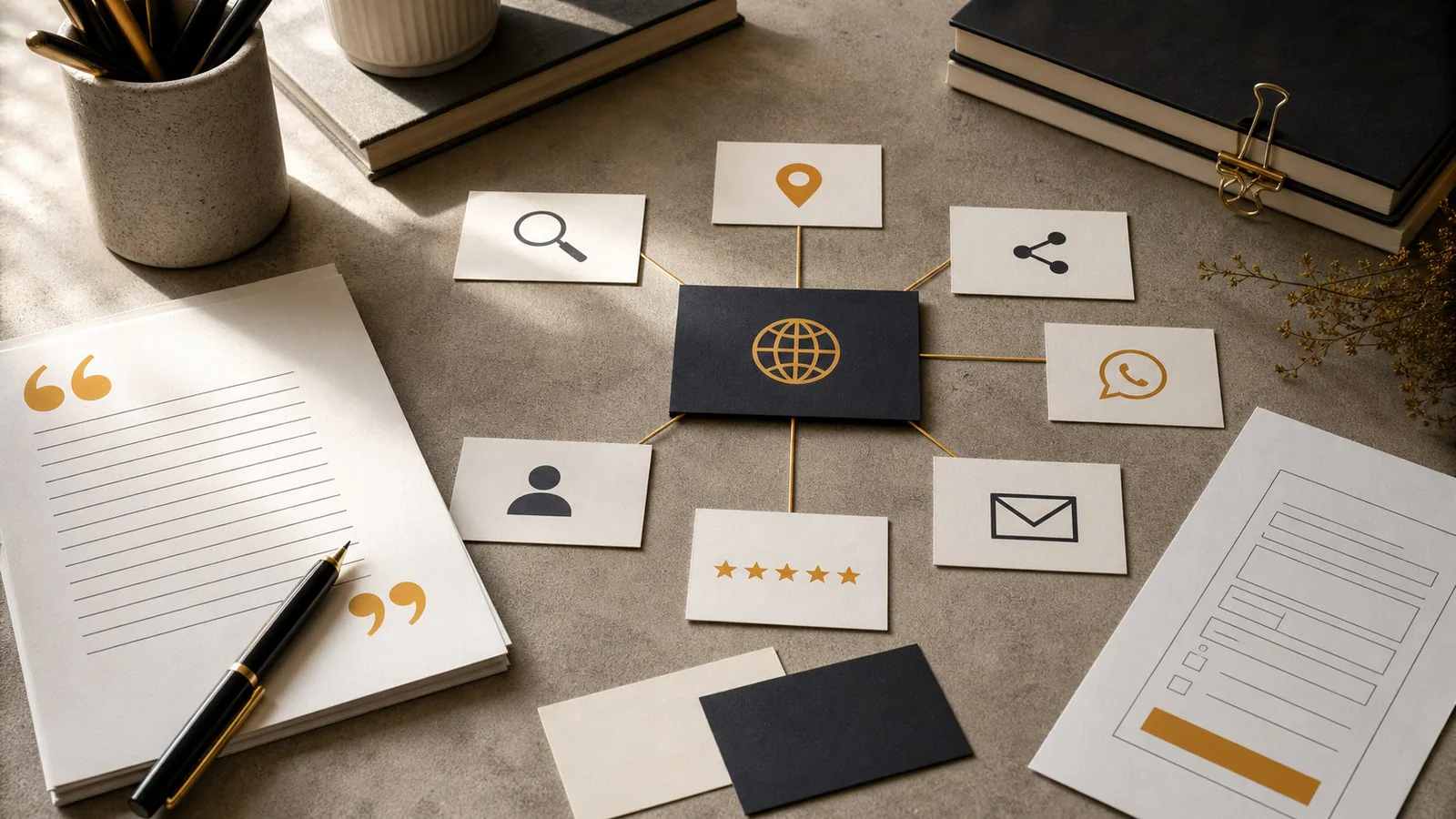
Yes. Small businesses still need a website in 2026 because social media, Google Business Profile, WhatsApp and AI answers are discovery channels, not a full owned presence. A website gives customers structured proof, service details, pricing context, business email trust, local SEO pages and clear enquiry paths that your business controls.
Yes, most small businesses still need a website in 2026. The interesting part is not the yes. It is the job a website still performs after Google Business Profile, social media, WhatsApp and AI tools have already helped a customer find you.
Each of those channels can create attention. Yet there is a point between discovery and enquiry where the customer needs to judge your services, proof, pricing context and legitimacy together. When that point is missing, the business owner often has to rebuild trust manually in every message or phone call.
This article follows that gap through the customer journey. By the end, you should know whether your current channels already cover it or whether potential customers are still being asked to piece your business together from scattered clues.
Why this question comes up
The objection is understandable.
A small business owner may already have:
- A Google Business Profile.
- An Instagram or Facebook page.
- A WhatsApp Business number.
- Customer reviews.
- A few posts showing recent work.
- Referrals from people who already know the business.
That can feel like enough, especially when cash flow is tight and the business is still finding its feet.
There is also more noise around AI search and answer engines. Some buyers now ask tools for recommendations instead of searching the old way. That makes some business owners wonder whether a normal website is becoming less important.
The practical view is this: discovery is spreading across more places, but buyers still need reliable proof before they contact you. Your website gives those channels somewhere solid to point.
The distinction becomes clearer when each channel is given one job instead of being expected to carry the whole sale.
Social media is useful, but it is not your base
Social media is good for visibility, reminders and showing activity.
It is less reliable as your main business home.
A social profile is built around a feed. Posts move down. Important details get buried. Layouts change. Account access can be lost. Algorithms decide who sees what. A potential customer may have to scroll through old content just to understand what you actually do, where you work, what it costs, and how to start.
That is not how a serious buyer wants to make a decision.
A website lets you organise the important questions:
- What do you offer?
- Who is it for?
- Where do you work?
- What does it cost from?
- What makes you credible?
- What should the customer do next?
Social media can support that. It should not have to carry all of it.
Google Business Profile is important, but it works better with a website
For local businesses, a Google Business Profile is one of the most important discovery tools you can have. It can show your business in Google Search and Maps, and it gives customers quick access to your phone number, hours, reviews, photos and directions.
Google’s own Business Profile guidelines focus heavily on accurate, real-world business information. They also refer to using a website or phone number that represents the individual business location.
That matters because your profile is not a full website. It is a listing.
Your Business Profile can show that you exist. Your website can explain why a customer should choose you.
For example, a plumber, accountant, guesthouse, dentist, solar installer, law firm or web design company can use a website to explain services in detail, answer common questions, show proof, publish service-area pages and guide visitors towards an enquiry.
That is why IDJoy usually recommends using both. Your Google Business Profile helps people find you. Your website helps them decide. The article on Google Business Profile and your website explains that relationship in more detail.
WhatsApp is a contact channel, not a sales system
WhatsApp is excellent for quick communication in South Africa. Many customers prefer it because it is familiar and low friction.
But WhatsApp usually works best after a customer has enough confidence to start a conversation.
If your only call to action is “WhatsApp me”, you may get more low-context messages: how much, where are you, what do you do, can you send photos, are you legit?
A website can answer the basic questions before the chat starts. That means the enquiry is more qualified.
Instead of using WhatsApp to explain your business from scratch every time, your website can give customers a clear overview first. Then WhatsApp becomes the next step, not the whole customer journey.
The same issue appears in AI search. The tool can introduce a business, but it still needs reliable public information to explain it correctly.
AI answers still need sources to work from
AI search and answer tools can summarise information, compare options and suggest businesses. But they still need public information to understand what a business does.
A clear website gives your business structured, crawlable information:
- Service pages.
- Location or service-area pages.
- FAQs.
- Pricing context.
- About information.
- Case studies or examples.
- Contact details.
- Business name, address and phone consistency.
Google’s SEO starter guide explains that SEO helps search engines understand your content and helps users decide whether to visit your site from search results. It also recommends logical site organisation, descriptive URLs, useful content, headings and links.
Those are website strengths.
If your information only exists inside social posts, screenshots, PDFs, old captions or private chats, it is harder for search systems and potential customers to understand your business clearly.
A website gives you owned proof
A good small business website is not just an online brochure. It is proof.
It can show:
- Your business name and domain.
- Professional business email.
- Services and service areas.
- Photos of real work.
- Testimonials or reviews.
- Credentials, memberships or guarantees.
- Team or founder information.
- Clear contact options.
- Pricing ranges or package starting points.
- Terms, policies or frequently asked questions.
This proof is especially important when the buyer does not already know you.
A referral may get someone to your name. Your website can help them feel safe enough to contact you. The article on what makes a business website look trustworthy covers that trust layer in more detail.
Business email still affects trust
A website also makes it easier to use a proper business email address, such as [email protected] instead of a personal Gmail address.
This is not about looking fancy. It is about reducing doubt.
For some businesses, a Gmail address is fine in the early days. But for professional services, higher-value projects, business-to-business work and organisations asking for sensitive information, a branded email address can make the business feel more established and accountable.
It also keeps your brand consistent across proposals, invoices, signatures, your website and your Google Business Profile. The article on why a Gmail address can weaken business trust explains the decision point.
Websites help local SEO because each service gets a proper home
Local SEO is not only about ranking for your business name. It is about showing up when people search for the service they need in the area they need it.
A website helps you build pages around those searches.
For example:
- “electrician in Durbanville”
- “bookkeeper for small business in Johannesburg”
- “wedding photographer in Pretoria”
- “security company in Gqeberha”
- “website design for small business South Africa”
A social profile may mention these things somewhere, but a website can give each important service or location a dedicated page with a clear title, headings, copy, examples and enquiry path.
This does not mean stuffing keywords everywhere. It means explaining your services in the same plain language your customers use. The article on local SEO for South African service businesses goes deeper on that foundation.
Pricing needs context
Many small businesses avoid putting pricing on their website because every job is different.
That is understandable. But giving no pricing context can also create weak enquiries.
A website can explain pricing in a way that is useful without locking you into one number:
- “From” pricing.
- Package ranges.
- What affects the cost.
- What is included.
- What is not included.
- When a custom quote is needed.
- How the enquiry process works.
This helps customers self-qualify.
If someone has a R2,000 budget for a R25,000 project, it is better for both sides to know early. If someone is a good fit, clear pricing context can make them more confident to enquire. The article on small business website costs in South Africa explains how to think about this.
All these sections point to the same missing stage: helping an unfamiliar buyer move from “I found this business” to “I understand it well enough to make contact.” The next question is what the website needs to contain to perform that job.
What a small business website should include in 2026
A useful website does not need to be complicated.
For many South African small businesses, the essentials are:
- A clear home page that says what you do, who you help and where you work.
- A services page or sections that explain your main offers.
- Proof such as photos, testimonials, reviews, logos or examples.
- An about page or section that shows who is behind the business.
- Contact options including phone, email, WhatsApp and enquiry form where relevant.
- Service-area information for local search.
- Pricing context or a clear quote process.
- A professional domain and business email.
- Fast loading, mobile-friendly pages.
- Basic SEO structure with descriptive page titles, headings and URLs.
The goal is not to impress people with effects. The goal is to make the buyer’s next decision easier.
When a website may not be urgent
There are a few cases where a website may not be the first priority.
If you are testing a tiny side idea, selling only to people who already know you, or running a short-term project, a Google Business Profile, landing page or social profile may be enough for now.
But once the business depends on strangers trusting you, comparing you, requesting quotes or paying meaningful money, a proper website becomes much more important.
The question is not “Can I survive without a website?”
The better question is “How many better enquiries am I missing because people cannot quickly understand and trust my business?”
That question closes the gap introduced at the start. A website becomes urgent when discovery is already happening but trust and understanding still have to be rebuilt manually after every click or message.
Website, Google profile, social media and WhatsApp should work together
The strongest setup is usually not one channel. It is a connected system.
A practical setup looks like this:
- Google Business Profile helps local customers find you.
- Social media shows activity, personality and recent work.
- WhatsApp makes contact easy.
- Your website explains the offer, proof, pricing context and next step.
- Business email supports trust and professional communication.
Each channel has a job.
When everything points back to a clear website, the buyer does not have to piece together your business from scattered clues.
So, do you still need a website?
Yes, when your business depends on people who do not already know you.
Google Business Profile, social media, WhatsApp and AI answers can create discovery. The website covers the stage those channels handle poorly on their own: bringing services, proof, pricing context, local relevance and a clear next step into one controlled place.
That can produce more qualified enquiries, reduce repetitive questions and give search systems a clearer source to understand. It also means the customer does not have to reconstruct your credibility from old posts, screenshots and disconnected profiles.
Start with the basics: clear services, real proof, local relevance, pricing context and a simple enquiry path. You can review IDJoy’s website options on the pricing page.