
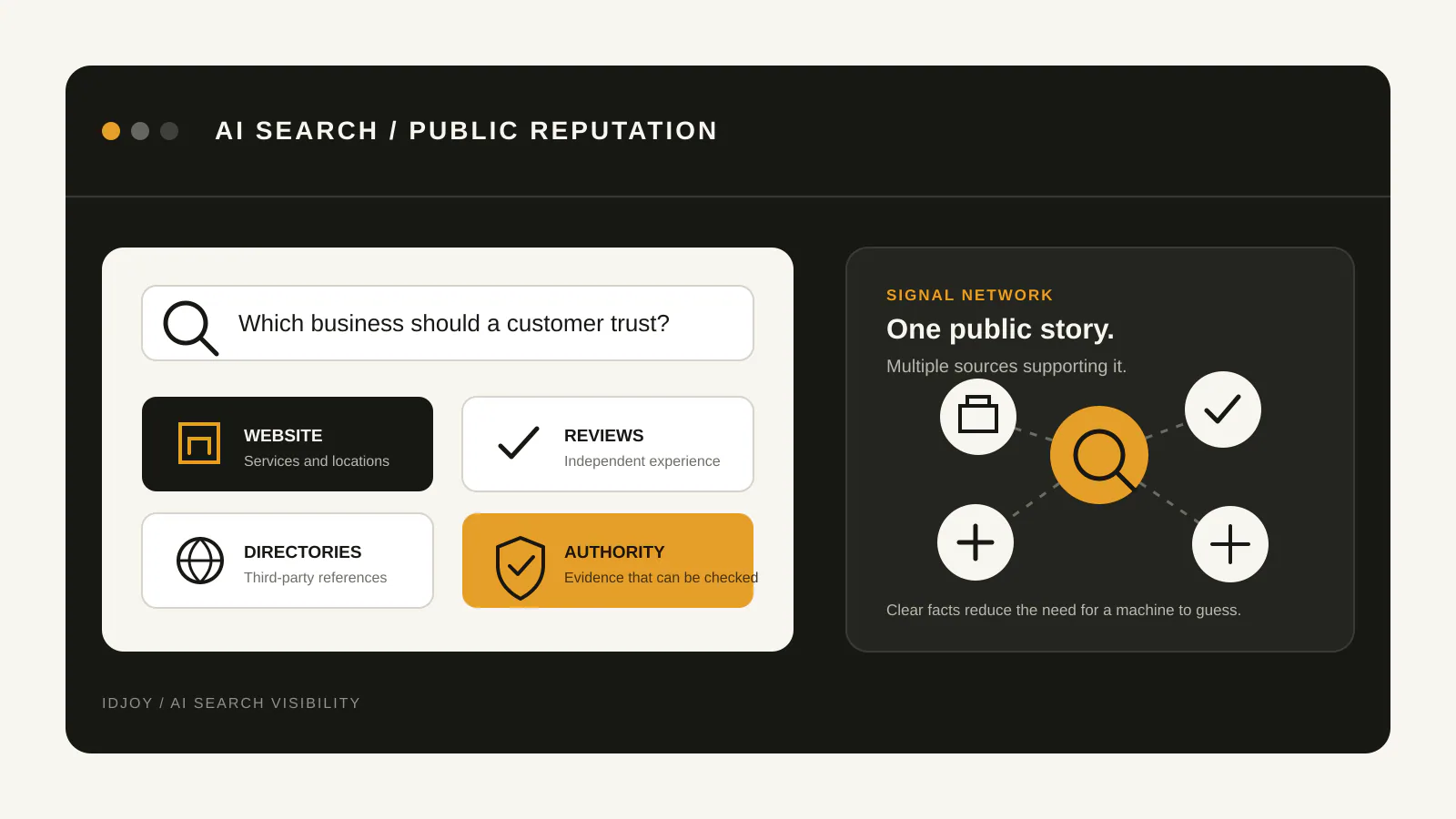
Reviews and third-party mentions can strengthen or weaken the evidence available about your business. They can confirm services, locations, reputation and customer experiences, but outdated or inaccurate listings can spread conflicting facts. Focus on genuine reviews and relevant independent sources, keep business details consistent and measure which sources appear in AI answers. Do not buy fake reviews or manufactured mentions for AI visibility.
Your website is one source about your business. It is not the only source a customer or search system can find.
A Google review can describe the service in the customer’s own words. A supplier directory can confirm an industry relationship. A client case study can connect your company to a real project. An old directory can also publish a phone number you stopped using three years ago.
That wider footprint matters because AI answers can be assembled from multiple public sources.
Start by mapping the public footprint
Search the business name, domain, phone number and key people connected to the company.
Create a source list:
- Google Business Profile;
- Google reviews;
- industry directories;
- supplier or partner pages;
- client websites;
- association memberships;
- social business profiles;
- event pages;
- press coverage;
- marketplace profiles;
- old domains;
- duplicate business listings.
Record the URL, date checked and whether the information is accurate.
The goal is not to collect hundreds of mentions. It is to understand which public sources say something meaningful about the business.
Reviews contain more than a star rating
A rating gives a quick signal. The review text can contain specific evidence.
A detailed review may confirm:
- service delivered;
- city or location;
- staff interaction;
- project type;
- timeliness;
- problem resolution;
- repeat work.
That does not mean you should tell customers what to write.
Ask for an honest review from a real customer. Google prohibits incentives for reviews and treats fake engagement seriously.
A natural mix of feedback is more credible than identical five-star comments published in a short burst.
Request reviews at a real completion point
Build the request into the customer workflow.
Possible moments include:
- after a project handover;
- after a support issue is resolved;
- after delivery is confirmed;
- after a repeat customer completes another order;
- after a client verbally says they are satisfied.
Google provides a review link or QR code businesses can share with customers.
Keep the request simple:
Thanks for working with us. If you have a moment, you can leave an honest Google review about your experience here: [review link].
Do not offer a discount, gift or payment in exchange for a positive review.
Respond to reviews for future customers
A review reply is public.
Use it to clarify relevant information rather than paste the same thank-you message under every review.
For a positive review, a short reply can acknowledge the actual work:
Thank you for trusting us with the website redesign. We appreciated working with your team through the content and launch stages.
For a negative review, respond to what can be addressed publicly and move private details to a direct conversation.
Do not publish customer information, argue about personal details or write a sales pitch underneath the complaint.
Google advises businesses to keep replies professional, relevant and concise.
Do not report a review because it is negative
Google’s review-removal process is for policy violations, not ordinary disagreement.
If a review contains spam, prohibited content or another policy violation, use the official reporting process.
If the review reflects a genuine customer dispute, reply professionally and fix the underlying business issue where possible.
A business that only wants positive reviews is not building a trustworthy source. It is trying to edit the customer record.
Check third-party listings for contradictions
Directories often outlive the data submitted to them.
Compare these fields:
| Field | Official website | Third-party source | Correct? |
|---|---|---|---|
| Business name | |||
| Domain | |||
| Phone | |||
| Address / area | |||
| Services | |||
| Opening hours |
Prioritise sources that rank for your business name or regularly appear in AI citations.
Correct business-controlled profiles first. Then use the publisher’s update or contact process for sources you do not control.
Earn mentions from relationships that already exist
A third-party mention does not need to be a press article.
Look at legitimate relationships:
- Are you listed as an approved supplier?
- Did a client publish the completed project?
- Does a professional association maintain a member directory?
- Are you speaking at an event with a public speaker page?
- Did a technology partner publish a case study?
- Does a local chamber list members?
Ask for accurate attribution when it makes sense to the relationship.
Do not turn every relationship into a link request. The page should be useful to that source’s audience first.
Publish case studies that create verifiable context
Your own case studies can make third-party evidence easier to connect.
Name the client only with permission. Explain:
- starting problem;
- scope;
- work completed;
- constraints;
- measurable result where verified;
- client quote where approved.
If the client also mentions the project on its own website or social channels, the public web has two independent perspectives on the relationship.
Do not invent a quote or performance number to make the case study stronger.
Track which sources AI answers actually use
Run a repeat prompt set and record cited or linked sources.
You may find that:
- Perplexity repeatedly cites one industry directory;
- ChatGPT links to your service page and a client article;
- Google surfaces Business Profile information and reviews for local queries;
- an outdated profile appears across multiple answers.
That observation tells you where maintenance matters.
Do not assume every mention on the web contributes equally.
Treat review themes as business research
Reviews can reveal language customers use that your website does not.
Group recurring themes:
- speed;
- communication;
- service quality;
- specific products;
- local convenience;
- staff expertise;
- after-sales support;
- problems customers repeatedly mention.
Use that language to improve service operations and customer-facing clarity.
Do not copy customer review text into marketing claims without permission or context.
If customers repeatedly praise a real differentiator, explain the underlying process on the website.
Watch for fake engagement risk
Google uses automated systems and expert review to fight fake business information and policy-violating reviews. It can remove reviews and apply restrictions when businesses violate fake-engagement policies.
That creates a simple rule for AI visibility work:
If the tactic requires pretending a person had an experience they did not have, do not use it.
The same principle applies to fabricated media sites, fake directories and paid “editorial” pages that hide the commercial relationship.
Build a monthly digital-footprint audit
Once a month or quarter, depending on how quickly the business changes, review:
- New reviews and responses.
- Business Profile accuracy.
- High-visibility directories.
- Partner and client mentions.
- Old domains or duplicate profiles.
- AI citations from your prompt baseline.
- Incorrect facts that need correction.
- Genuine new relationships worth documenting.
This gives the business a maintained public record rather than a one-time “GEO campaign”.
IDJoy’s AI search visibility work includes digital-footprint checks because accurate independent evidence can matter as much as another paragraph added to the homepage.