
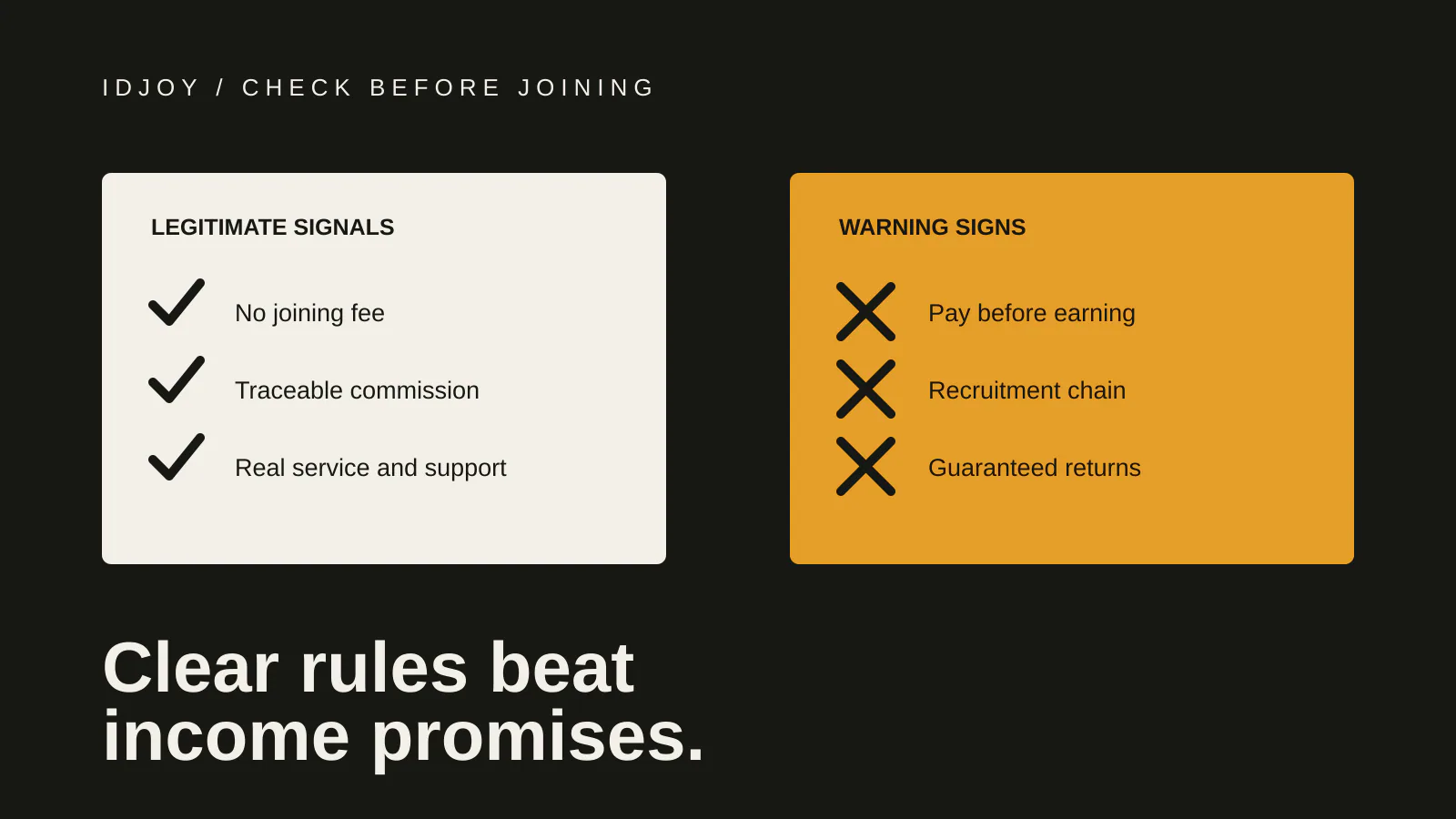
A legitimate affiliate programme should explain the product, work, commission calculation, payment trigger and business behind the offer. Be cautious when you must pay to join, recruit people to recover your money, buy stock, surrender an OTP or banking PIN, accept guaranteed-income claims, or share a link without disclosing that you may earn commission.
People searching for extra income are easy targets for offers that use urgency, shame or financial pressure to stop them asking basic questions.
A professional-looking website does not prove that an earning opportunity is safe. A WhatsApp testimonial does not prove that most members earn money. A screenshot of a bank balance does not explain where the money came from.
The useful test is simpler: can you identify the real business, understand the work, calculate the commission and explain exactly what must happen before payment?
Red flag 1: you must pay to join
A joining fee is not automatically illegal, but it changes the risk. Ask what you are buying and whether the programme earns mainly from customers or from new members.
Be cautious when the payment is described as:
- an activation fee;
- a starter package;
- compulsory training;
- a licence to begin earning;
- a higher level that unlocks serious income; or
- a once-off payment you will quickly recover by recruiting others.
A legitimate referral relationship can usually track introductions without charging the person who brings the lead.
IDJoy does not charge partners a joining fee or require stock purchases.
Red flag 2: recruitment matters more than the service
Ask what the end customer buys.
A normal referral programme pays because a customer bought a real service or product. A recruitment-led scheme focuses on bringing more participants into the earning structure.
Warning signs include:
- commission for recruiting partners rather than customers;
- pressure to build a “team” or “downline”;
- earnings diagrams dominated by member levels;
- little evidence of ordinary customers buying the underlying service; and
- advice to approach friends and family before you understand the offer.
In the IDJoy programme, commission is connected to eligible client work you introduced. Recruiting another partner does not create commission for you.
Red flag 3: guaranteed or effortless income
No honest referral programme can guarantee that a business will buy.
The business may already have a supplier, lack budget, delay the project or decide that the service is not suitable. Even a strong introduction can fail to close.
Treat phrases such as these with caution:
- guaranteed weekly income;
- earn while doing nothing;
- copy and paste this link for daily cash;
- financial freedom in thirty days;
- no skills, time or effort required; and
- everybody succeeds if they follow the system.
Referral work can be flexible, but it is still work. You need judgement, context and a useful introduction.
Red flag 4: the commission cannot be calculated
A credible programme should answer:
- What percentage or fixed amount applies?
- Which project value is used?
- Does VAT form part of the calculation?
- When is the rate fixed?
- Can the rate change after the sale?
- What happens when a client receives a refund or the project is cancelled?
- When does commission move from estimated to payable?
Be careful when earnings are described only with exceptional screenshots or phrases such as “up to R50,000” without showing the ordinary calculation.
IDJoy publishes current service and package prices and explains that commission depends on an eligible project closing. The programme page is the source of truth when prices or terms change.
Red flag 5: there is no attribution record
A referral programme needs a fair way to answer: who introduced the client?
Without a referral code, link, project record or timestamp, the business can later say that it cannot prove where the lead came from.
A solid system should show:
- your unique referral identity;
- the introduction you submitted;
- the client company or reference;
- the current status;
- duplicate handling;
- the commission calculation when applicable; and
- payout information after payment.
With IDJoy, the partner identity is resolved from the signed-in account. The browser does not choose a partner ID, which helps prevent another person from attaching your introduction to their account.
Red flag 6: you are told to hide the commission
People are more likely to distrust a recommendation when they discover later that it was paid.
Disclose the relationship clearly. For example:
“I am part of IDJoy’s referral programme and may earn commission if the company chooses to work with them.”
Disclosure does not weaken a relevant recommendation. It shows that you respect the person making the decision.
Also avoid contextless link drops. Recent online communities increasingly remove unexplained affiliate links because they are difficult to distinguish from spam, automated promotion and low-value content.
Red flag 7: private financial information is requested through chat
A legitimate payment process does not require your banking PIN or one-time password.
SARS repeated in July 2026 that it will not ask for passwords, OTPs, banking PINs or eFiling login credentials through email, SMS, social media or telephone. Apply the same caution to earning programmes.
Do not send these through WhatsApp, direct message or email:
- online-banking password;
- card PIN;
- banking-app approval code;
- OTP;
- eFiling password; or
- a photograph that exposes unnecessary identity or card information.
IDJoy banking details are entered inside the authenticated partner portal. The account number is encrypted and returned only in masked form. An administrator may verify details for payment, but should never ask for a PIN or OTP.
Red flag 8: there is no real business to contact
Check whether the programme shows:
- the registered or trading business name;
- a working company domain;
- a business email address;
- examples of the real service;
- clear terms or programme explanations;
- a privacy route; and
- a way to raise a question with a person.
A social-media profile alone is easier to replace or abandon than an established business presence.
Red flag 9: pressure replaces explanation
Scam pressure often sounds like:
- register before midnight;
- the opportunity is closing permanently;
- borrow the joining fee;
- do not discuss it with negative people;
- your questions show that you lack the right mindset; or
- move the conversation away from the official platform.
A legitimate programme should allow you to read, compare and decline.
A ten-question check before joining
Ask these questions in writing:
- What does the customer buy?
- Who delivers it?
- Do I pay anything?
- Do I earn from recruiting other participants?
- How is my introduction recorded?
- What makes a referral duplicate?
- What event makes commission payable?
- What records will I receive?
- How are banking details protected?
- Who can I contact when a status looks wrong?
Unclear answers are information. Do not let urgency force you to ignore them.
What IDJoy’s programme does and does not promise
IDJoy’s programme is free to join. It does not require stock or recruitment. Partners receive a referral link and can log projects. IDJoy handles the sales and delivery work. Commission depends on eligible client work closing and being paid.
That still does not guarantee income. The programme may suit people who already encounter service businesses and can make thoughtful introductions. It is unlikely to suit somebody looking for automatic daily returns from posting a link everywhere.
Read the full Earn With IDJoy programme or compare the other careers guides.