
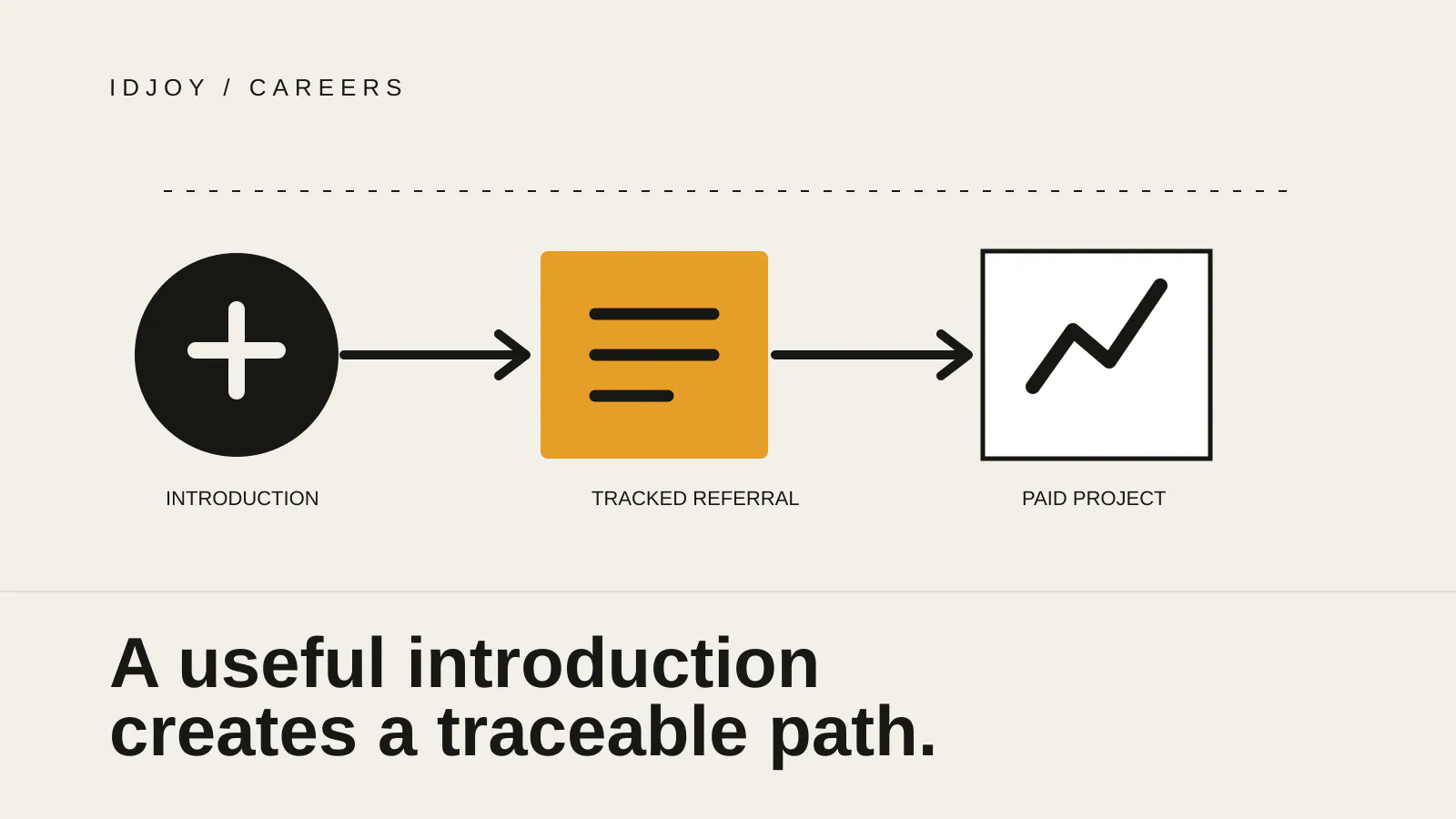
Referral income is earned by making a traceable introduction that becomes a paid project. A legitimate programme should be free to join, explain the work and commission rules, disclose when payment becomes due, and never promise guaranteed income. With IDJoy, partners introduce suitable South African businesses while IDJoy handles the sales conversation, quotation, delivery and invoicing.
South Africans searching for extra income are often shown two extremes: a second job with fixed hours, or an online scheme claiming that money will arrive while they sleep. Referral work sits between those extremes.
It is flexible, but it is not passive. You need to notice a genuine problem, know or find the right business and make an introduction that has a reasonable chance of becoming paid work.
That distinction matters. Recent South African discussions about side work repeatedly ask for something legitimate, flexible and free to join. People are not only asking, “How much can I earn?” They are asking, “What do I actually have to do, and how do I know this is not a scam?”
What referral income means
Referral income is commission paid after your introduction creates measurable business for another company.
In the IDJoy partner programme, that usually starts when you notice a South African business with a digital problem, such as:
- a company using only Facebook or WhatsApp with no website;
- a business still sending quotations from a free personal email address;
- a website that does not explain specialised services clearly;
- a new business that needs a logo, profile and professional presence;
- an established company that cannot be found when buyers search online; or
- a team losing enquiries because its website has no clear next step.
You are not expected to design the website, calculate the price or promise a result. Your role is to identify a reasonable fit and make the introduction. IDJoy handles the sales conversation, scope, quotation, work and invoicing.
How the process works
1. Register without paying a joining fee
A referral programme should not require you to pay before you can earn. IDJoy does not charge a joining fee, require stock or create paid ranks that unlock higher levels.
After registration, your partner profile receives a referral code and a shareable link. The link makes it possible to trace a website enquiry back to your profile.
2. Look for a real business problem
A useful introduction begins with evidence, not a mass message.
Compare these two approaches:
“Hi, do you need a website?”
and:
“I noticed your company profile lists five industrial services, but your current page does not separate them or show how a buyer should request a quotation. I work with a web studio that solves that type of problem. May I introduce you?”
The second message is more useful because it names a visible problem. Even when the business says no, the conversation is respectful and specific.
3. Disclose your relationship
Tell the business that you may earn commission if a project closes. Disclosure protects trust and makes it clear that you are introducing a provider, not pretending to give completely independent advice.
A simple line is enough:
“For transparency, I am part of IDJoy’s referral programme and may earn commission if you choose to work with them.”
Do not hide the relationship in small text or wait until after the introduction.
4. Use the referral link or add the project
Your referral link is useful when the business wants to inspect IDJoy’s work first. You can share it through WhatsApp, email or another relevant conversation.
You can also add a project while signed in. The portal associates the introduction with your authenticated partner profile. You should never need to type or choose your own partner ID.
The programme uses an attribution window and duplicate-company checks. This means a company already attributed to another partner cannot simply be claimed again because somebody entered the name a second time.
5. Follow the real outcome
An introduction is not automatically a sale. The business may decline, delay the decision, request a smaller service or choose another provider.
Your dashboard should show the referral status so you can distinguish:
- a submitted introduction;
- a conversation in progress;
- a duplicate or rejected lead;
- a project that was won; and
- commission that has moved into a payout.
This is one reason tracked referral work is more credible than a vague promise that somebody will contact you when money is available.
How much can a referral pay?
The amount depends on the project value and your applicable commission rate. IDJoy publishes service and package prices so a partner can estimate the arithmetic instead of relying on an unexplained number.
A smaller service may produce a few hundred rand in commission. A broader website and brand project can produce more. Neither result is guaranteed, because the client must choose and pay for the work.
Treat referral income as variable income, not a fixed salary. Do not commit rent, debt repayments or essential expenses based on a lead that has not closed.
Who is this suitable for?
Referral work can suit people who already speak to business owners or regularly notice business problems, including:
- accountants, consultants and business-support practitioners;
- print shops, photographers and signage companies;
- salespeople and account managers;
- community organisers and networking-group members;
- freelancers whose clients need services outside their own scope;
- employees who meet suppliers and small-business owners through normal work; and
- founders who frequently receive requests they cannot fulfil themselves.
Check your employment agreement before doing outside work. Avoid using confidential employer information, company time or relationships you are not authorised to approach.
What referral income is not
It is not guaranteed income. It is not a salary. It is not a recruitment chain. It is not a reason to send unsolicited links to hundreds of strangers.
The programme works best when the introduction is relevant and the business can clearly see why the conversation may help.
A partner who sends five careful introductions can be more valuable than somebody who drops the same link into fifty unrelated groups.
Keep records for tax purposes
SARS states that other income, including income from business activities, may be taxable. Whether tax is due depends on your total income and circumstances.
Keep:
- payout statements;
- proof-of-payment documents;
- dates and payment references;
- relevant expenses and supporting records; and
- any tax advice you receive.
Do not rely on a social-media post to decide whether you must register, declare income or submit provisional tax. Use current SARS information or consult a registered tax practitioner.
Start by checking the programme, not by registering blindly
Read the published commission examples, the attribution rules and the payment conditions. Confirm that the programme is free to join and that you understand what happens when a lead duplicates an existing referral.
Then decide whether you know the kinds of South African service businesses IDJoy is built to help.
Review the Earn With IDJoy partner programme or read the careers and extra-income hub.