
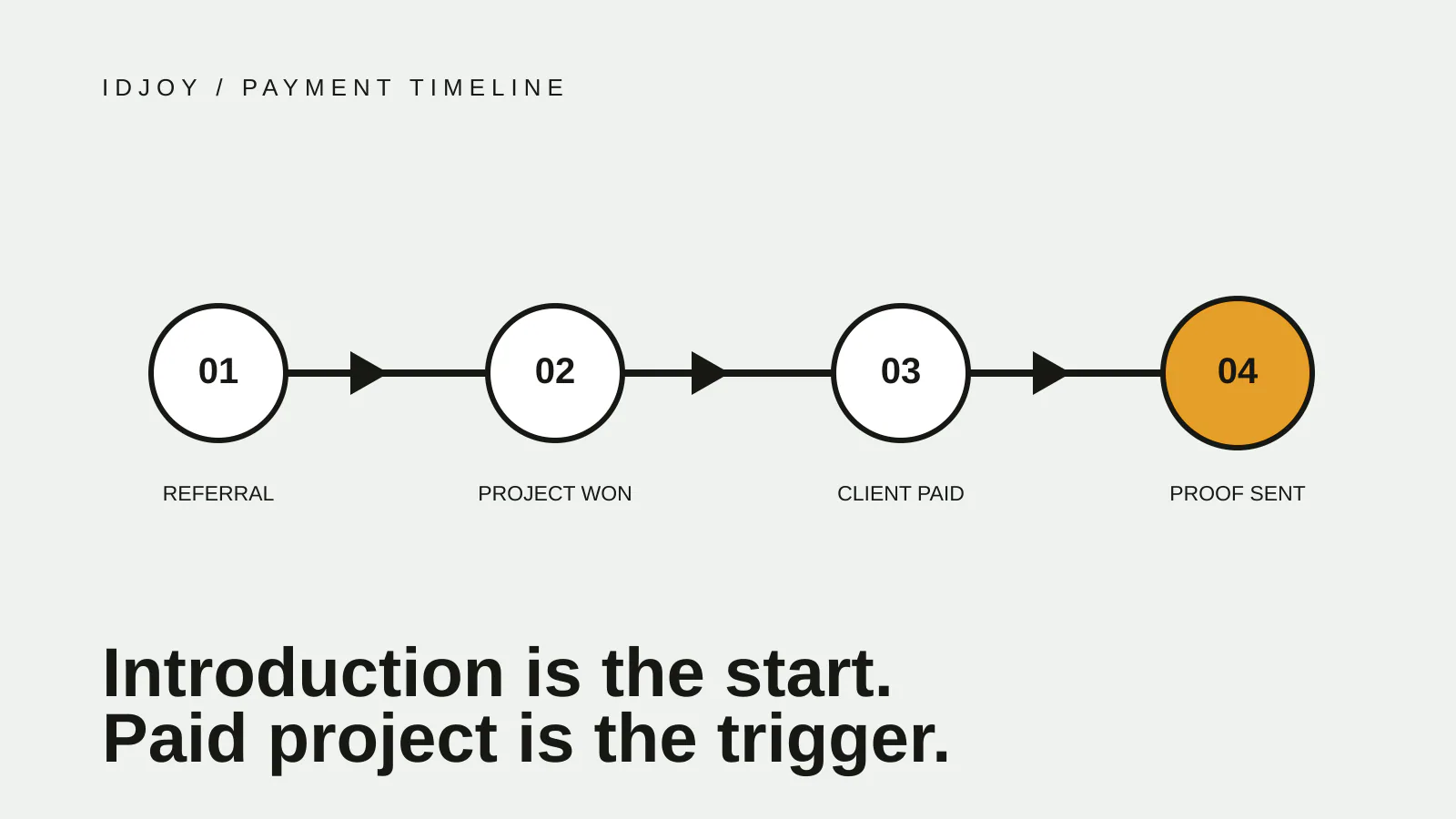
Referral commission is normally paid only after the introduction becomes an eligible sale and the client pays the relevant invoice. An introduction alone is not commission. With IDJoy, the referral is tracked, the project value and rate are confirmed when the work is won, banking details must be verified, and the payout receives a payment reference and proof after payment.
A referral can be valuable before it produces money, but it is not yet commission.
This is where many earning programmes create confusion. They use words such as “earned”, “pending”, “approved” and “payable” as though they mean the same thing. They do not.
A transparent programme separates the introduction, the sale, the client payment and the partner payout.
The four events people often confuse
1. You submitted a referral
You identified a business and logged the introduction or shared your referral link.
At this stage:
- the company may not have replied;
- IDJoy may not have qualified the need;
- no quotation may exist;
- the business has not agreed to buy; and
- there is no commission to pay.
The referral record is important because it protects attribution. It does not turn a possible opportunity into money.
2. The business accepted a project
The client accepted the relevant proposal and the referral can be marked as won.
This is the point where the system can record:
- the project value;
- the partner’s applicable commission rate;
- the calculated commission amount; and
- the date the project was won.
The calculation should be fixed against that referral rather than changing later because the partner moved to another tier.
Even here, the client may not yet have paid the invoice.
3. The client paid IDJoy
A commission-based business cannot safely pay out money it has not received. The client invoice therefore needs to be settled according to the project terms before the partner payout is completed.
This protects both sides. Paying commission before the client pays can create disputes when a project is cancelled, reduced or refunded.
4. IDJoy paid the partner
The payout is complete when IDJoy sends the money to the verified bank account and records the payment information.
A useful payout record includes:
- payout reference;
- amount;
- payment date;
- bank-transfer method;
- expected reflection guidance; and
- proof of payment.
This gives the partner something concrete to check instead of relying on a message saying, “It has been paid.”
A practical IDJoy referral timeline
The exact number of days varies because clients make decisions and pay at different speeds. The sequence should remain consistent.
Stage 1: submitted
You add the client company, contact details, service need and useful context. The system timestamps the referral and associates it with your partner profile.
A duplicate check may flag the company when another current referral already has valid attribution.
Stage 2: contacted or qualified
IDJoy reviews the introduction and contacts the business where appropriate. Some leads stop here because there is no current need, no budget or no fit.
A rejected or lost lead does not become commission.
Stage 3: quoted or in discussion
The business receives a proposal or discusses scope. A quotation is evidence of progress, not a promise that the deal will close.
Do not spend expected commission at this stage.
Stage 4: won
The client accepts the project. IDJoy records the project value and commission rate. The commission calculation can now appear against the referral.
“Won” means the commercial decision has been made. It does not necessarily mean the client has already paid every amount required for the partner payout.
Stage 5: payable
The relevant client payment has cleared and the commission is eligible to enter a payout. Any required banking verification must also be complete.
If you changed your banking details, verification should reset. This prevents a last-minute account change from redirecting a payment without review.
Stage 6: paid
IDJoy sends the payment, records the reference and makes proof of payment available. Bank processing can affect when the money appears in the receiving account.
Why banking details need verification
An account number is a payment credential. A programme should not collect it casually through a public signup form or ordinary message.
The IDJoy portal stores banking details separately from the public partner profile. The account number is encrypted, and the partner sees only a masked confirmation after saving.
An administrator verifies the details before a payout can be marked paid. Any later change clears that verification.
This creates a deliberate pause, but it helps prevent payment to an incorrect or recently substituted account.
Why an EFT may not reflect immediately
IDJoy pays from Capitec Business Banking.
The receiving time depends on the payment method and bank:
- Capitec to Capitec: usually reflects shortly after sending, although temporary bank or network delays can occur.
- Immediate payment to another bank: normally reflects within seconds or minutes, but a receiving bank or network issue can delay it.
- Standard EFT to another bank: is not instant and may take several hours or longer. A payment made after a processing cut-off, on a weekend or public holiday may reflect on the next business day.
The proof of payment confirms that the transfer was initiated. It does not override the receiving bank’s processing time.
What to check when a payment has not reflected
Before assuming that a payout failed, check:
- the payment date and time;
- whether it was standard or immediate;
- whether a weekend or public holiday intervened;
- the payment reference;
- the masked account ending shown in your settings;
- whether you recently changed banking details; and
- the proof-of-payment document.
Then contact IDJoy through the partner message thread. Keep payout questions in the portal so the payment, account status and conversation can be reviewed together.
Never send an OTP, online-banking password or banking PIN to “speed up” a payment investigation.
What if the client pays in instalments?
The referral agreement and payout policy determine which client payment activates commission. A project may involve a deposit, milestone payments or a final balance.
Do not assume that the first deposit automatically means the full commission is payable. The portal status and payout record are the reliable sources.
The programme should explain the applicable rule before the partner relies on a date.
What records should you keep?
Download or retain:
- the payout reference;
- proof of payment;
- payout amount and date;
- related referral or project reference;
- bank statement showing receipt; and
- relevant tax records.
SARS states that other income, including business income, may be taxable depending on your overall circumstances. Good records make it easier to declare income correctly or answer questions later.
The honest expectation
A good introduction may take days, weeks or months to become paid work. Some never close. That does not mean the tracking system failed; it means referral income depends on a real buying decision.
The useful promise is transparency, not speed: you should be able to see what was introduced, what happened, what commission was calculated and what payment was sent.
Read the full Earn With IDJoy programme or explore the South African careers hub.