
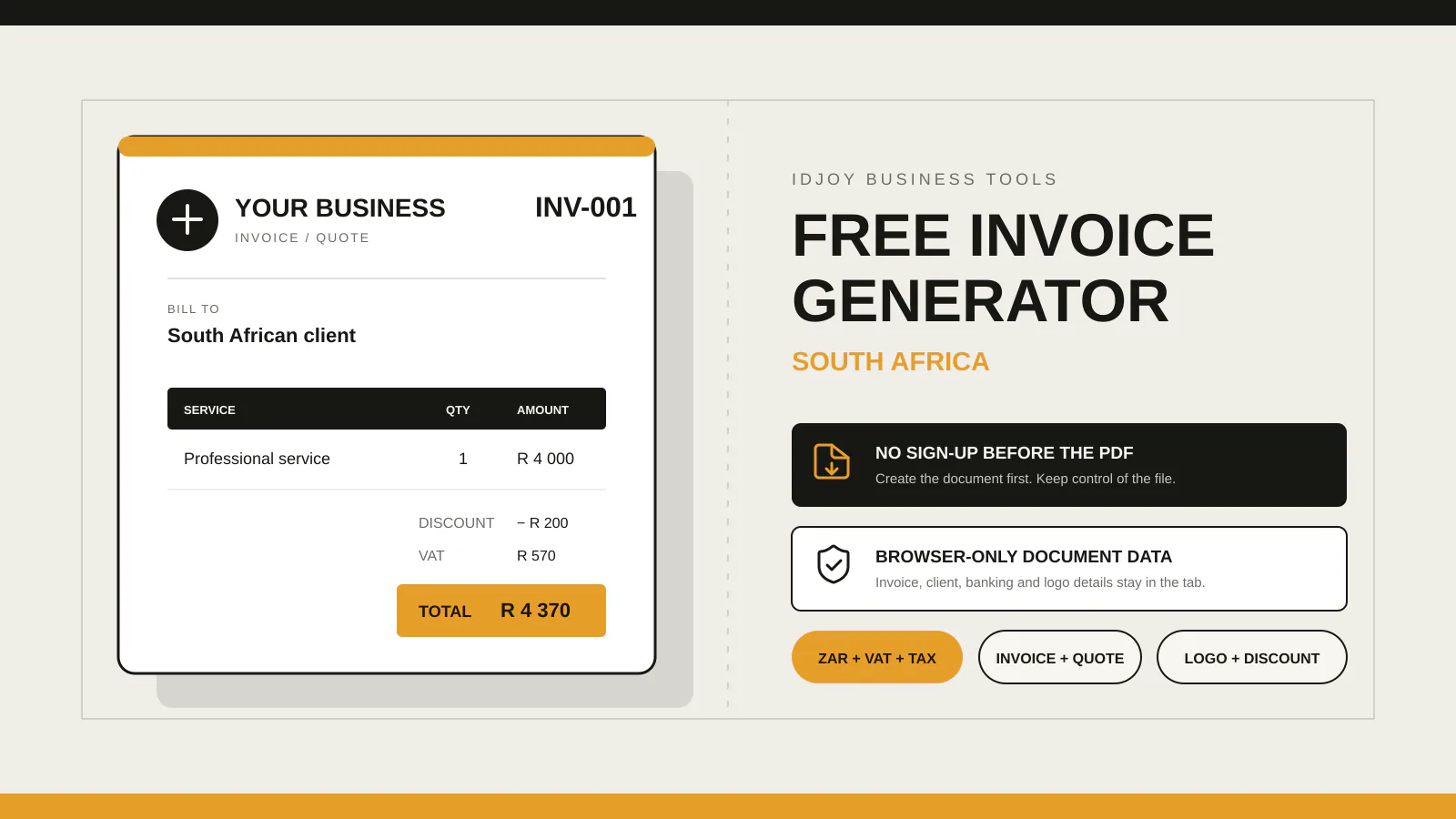
A South African VAT vendor must issue a tax invoice with the information SARS requires for the transaction. A full tax invoice is generally required when consideration exceeds R5,000. It must identify the supplier, recipient where required, serial number, issue date, goods or services, quantity or volume, value and VAT information. Check the current SARS rules before relying on a template.
An invoice can look professional and still be missing information needed for a South African VAT tax invoice.
The distinction matters because a tax invoice is not simply a document with “VAT” added to the total. SARS specifies who can issue one, when it must be issued and which details it must contain.
This guide turns those requirements into a practical review. It is general information, not tax advice. If the transaction is unusual, cross-border, zero-rated, exempt or subject to a special VAT rule, confirm the treatment with SARS guidance or a tax professional.
First check whether you are a VAT vendor
A business that is not registered for VAT should not present itself as charging VAT as a registered vendor.
Before checking the layout, confirm:
- the supplier is VAT registered where a VAT tax invoice is being issued;
- the VAT registration number is correct;
- the VAT treatment matches the actual supply;
- the invoice date and transaction fall under the applicable rules.
The free IDJoy Invoice Generator lets you enter a VAT percentage, but a calculator cannot decide whether your business should charge VAT. That remains the business’s responsibility.
Full tax invoice or abridged tax invoice?
SARS distinguishes between a full tax invoice and an abridged tax invoice based on the consideration for the supply.
A full tax invoice is generally required when the consideration exceeds R5,000. An abridged tax invoice can generally be used where the consideration is R5,000 or less.
For very small purchases of R50 or less, SARS states that a tax invoice is not required, although the purchaser should retain a till slip or docket to support an input-tax deduction where applicable.
Do not use the thresholds as a reason to remove information that your customer, procurement team or accounting process needs. A fuller invoice can still be the clearer business document.
The wording at the top matters
A tax invoice should clearly contain the words:
- “Tax Invoice”;
- “VAT Invoice”; or
- “Invoice”.
Do not label a quotation as a tax invoice. A quote proposes a transaction. An invoice records an amount due for a supply under the relevant commercial and tax circumstances.
If your workflow starts with a quotation, issue the correct invoice document when the transaction reaches that stage.
Supplier details
A full tax invoice should identify the supplier.
Check that the document includes:
- supplier name;
- supplier address; and
- supplier VAT registration number.
Use the same business identity across the invoice, website, bank account instructions and customer communication. A customer should not have to guess whether two different names refer to the same supplier.
If the trading name differs from the registered legal name, make the relationship clear where your accounting or procurement process requires it.
Recipient details
For a full tax invoice, check the recipient information required by SARS, including:
- recipient name;
- recipient address; and
- recipient VAT registration number when the recipient is a registered vendor and that field is required for the invoice.
Do not collect a VAT number simply because the form has a field for it. Ask for it when the transaction and customer require it.
For business-to-business work, accurate recipient details also reduce disputes when the invoice reaches accounts payable.
Use a unique serial number
The tax invoice needs a serial number.
A simple sequence can work:
INV-2026-001
INV-2026-002
INV-2026-003
The exact format is a business decision. The important part is that the numbering lets the business distinguish and trace documents reliably.
Avoid repeatedly sending different invoices with the same number. It creates unnecessary confusion during payment matching, bookkeeping and later corrections.
Record the issue date
Include the date the tax invoice is issued.
SARS states that a tax invoice should generally be issued within 21 days of the date of the supply.
Your payment due date is a separate field. “Issued 9 August, payment due 23 August” tells the customer both when the document was created and when you expect payment.
Do not replace the issue date with a due date.
Describe the goods or services accurately
“Services rendered” may be too vague for the customer to verify what they are paying for.
Use a description that connects the invoice to the real work:
- Website redesign: homepage and five service pages;
- Monthly website maintenance: August 2026;
- Brand identity design: logo system and brand guidelines;
- 12 units of specified product.
SARS requires an accurate description of the goods or services supplied. Clear descriptions also reduce payment queries.
Include quantity or volume
Where applicable, state the quantity or volume of the goods or services.
For a product this may be units, kilograms or litres. For a service it can be a quantity of one, a number of sessions, hours, licences or another meaningful unit.
Do not force an artificial unit that makes the invoice less clear. Use the structure that accurately reflects the transaction and your accounting treatment.
Show value and VAT clearly
The document must make the monetary treatment understandable.
Depending on the way the invoice is expressed, check that the customer can identify:
- value of the supply;
- VAT amount or the information SARS permits for calculating it; and
- total consideration.
Do not hide VAT inside an unexplained total.
If a discount applies, show where the discount enters the calculation so the customer can reproduce the final amount. If the tax treatment of a discount is material to your transaction, confirm it with your accountant or SARS guidance.
Keep banking details separate from tax requirements
Banking details are commercially useful, but they do not replace required tax-invoice information.
A payment section can include:
- bank name;
- account holder;
- account number;
- branch code;
- payment reference.
Protect this section carefully. If banking details change, verify the change through a trusted business channel. Invoice-fraud emails often try to redirect customers to a different account.
Use this final review before sending
Before the PDF leaves your business, check:
- Correct document type appears at the top.
- Supplier name and address are correct.
- Supplier VAT number is correct where applicable.
- Recipient details are complete for the invoice type.
- Recipient VAT number is included where required.
- Invoice number is unique.
- Issue date is present.
- Goods or services are described accurately.
- Quantity or volume is shown where applicable.
- Value, VAT and total can be understood.
- The arithmetic matches the line items.
- Payment details belong to the supplier.
- The PDF is readable on a phone and computer.
- A copy is retained under the business’s record-keeping process.
The downloadable checklist below turns those points into a working sheet you can keep with your invoicing procedure.
A generator helps with structure, not tax judgement
IDJoy’s free tool can calculate line items, VAT percentages and totals and can turn the finished document into a PDF. It does not know whether a supply is standard-rated, zero-rated, exempt or subject to a special rule, and it cannot guarantee that a document is compliant for every transaction.
Use the tool for document structure and arithmetic. Use current SARS guidance and professional advice for tax treatment.
You can open the free IDJoy Invoice Generator without creating an account or storing client details with IDJoy.