
Use a quotation to propose a price before the supply is final. A non-VAT-registered business can issue an ordinary commercial invoice but should not charge VAT as a registered vendor. A registered VAT vendor must issue the tax invoice required for taxable supplies. If VAT registration is pending after liability has started, SARS has specific rules for collecting VAT and issuing the formal tax invoice after registration confirmation.
A quotation, ordinary invoice and VAT tax invoice can contain similar line items. They do not mean the same thing.
The right document depends on two separate questions:
- Has the customer accepted a proposed transaction, or are you still pricing it?
- Is the supplier actually registered or liable for VAT under the applicable rules?
Do not solve either question by changing the heading on a PDF.
Use a quotation before the customer commits
A quotation is a commercial proposal.
It can show:
- service or product description;
- quantity;
- price;
- estimated taxes where applicable;
- validity period if your business uses one;
- payment terms;
- expected delivery or project timing;
- assumptions or exclusions;
- customer details.
A quotation helps the customer decide whether to proceed.
It is not evidence that payment is already due merely because it has a total at the bottom.
When the customer accepts the quote, your sales process can move to the next document required by the transaction: deposit invoice, tax invoice, order confirmation or another document appropriate to the business.
A non-VAT business can still issue an invoice
A South African business does not need to be VAT registered to send an invoice for money owed.
The invoice can include:
- supplier name;
- customer details;
- invoice number;
- date;
- services or goods;
- quantities;
- prices;
- total due;
- banking details;
- payment terms.
What it should not do is represent the supplier as charging VAT as a registered vendor when that is not the business’s actual status.
Do not add a 15% VAT line simply because the template has one.
The current standard VAT rate is 15%, but the rate applies through the VAT system to registered vendors and taxable supplies. The supplier’s registration status and the supply matter first.
A registered VAT vendor has tax-invoice obligations
SARS says registered vendors must collect VAT on taxable supplies, include VAT in advertised or quoted prices and issue tax invoices where required.
For a full tax invoice, SARS lists information including:
- the words “Tax Invoice”, “VAT Invoice” or “Invoice”;
- supplier name, address and VAT registration number;
- recipient name and address and, when the recipient is a vendor, its VAT number;
- serial number and issue date;
- accurate description of goods or services;
- quantity or volume;
- value of the supply;
- VAT charged;
- total consideration.
SARS says a full tax invoice is required when consideration exceeds R5,000, while an abridged tax invoice may be used at R5,000 or less. At R50 or less, a tax invoice is not required, although documentary proof can still matter for input tax.
Use the South African tax-invoice checklist before treating a generic invoice template as complete.
Do not confuse a quotation with a tax invoice
A VAT-registered vendor can include VAT in a quotation because SARS requires VAT to be included in advertised or quoted prices.
That does not turn the quote into the final tax invoice.
The quotation is still the proposed commercial document. The tax invoice is issued according to the VAT rules when required for the actual supply.
Keep the document type visible so the customer knows whether they are approving a price or being asked to pay an invoice.
Use a simple decision table
| Situation | Document to consider | VAT line? |
|---|---|---|
| Customer has not approved the work | Quotation | Show VAT treatment only if it applies to the supplier and quote |
| Non-VAT-registered supplier has completed or billed work | Ordinary invoice | Do not present VAT as charged by a registered vendor |
| Registered VAT vendor makes a taxable supply | Tax invoice where required | Yes, according to the supply and VAT rules |
| Registered vendor needs to propose price first | Quotation, then tax invoice at the required stage | Quote should reflect applicable VAT pricing |
| VAT registration is pending after liability date | Follow SARS pending-registration rules | Do not guess from confirmation status alone |
The table is a starting point. Special transactions can have different VAT treatment.
Pending VAT registration needs extra care
This is where a simple “registered or not registered” switch can become misleading.
SARS explained in VAT Connect Issue 20 that the obligation to levy and collect VAT can start from the liability date, even while the vendor is still waiting for registration confirmation. At the same time, section 20 requires a “registered vendor” to issue a tax invoice, so the supplier cannot issue the formal tax invoice until registration is confirmed. SARS says the required tax invoices should then be issued as soon as possible after confirmation.
If your registration is pending and the liability date has already started, do not use a generic invoice article as the only basis for treatment. Confirm the effective date and required process with SARS or a tax practitioner.
Put VAT status in the business process, not only the template
Your invoice generator should not be the only place that knows whether the business is VAT registered.
Document:
- VAT registration number;
- effective registration date;
- current status;
- standard document type;
- who verifies tax settings;
- where the official SARS notice is stored;
- how quotations display VAT;
- how invoices display VAT.
This reduces the risk of one staff member sending a VAT invoice while another sends a no-VAT document from a different template.
Keep quotation numbering and invoice numbering traceable
A quotation and invoice can use separate sequences.
Example:
QUO-2026-014
INV-2026-061
The numbering system should let the business trace the relationship between the documents without reusing the same document number for different transactions.
If a quote becomes an invoice, keep the original quote for the audit trail rather than overwriting the PDF and changing its heading.
Make the payment request unambiguous
An invoice should tell the customer:
- amount due;
- due date;
- payment reference;
- bank or payment method;
- contact for a dispute or query.
A quotation should instead make the approval step clear.
This separation can reduce the common customer question: “Do you need me to pay this now, or is this only the quote?”
Do not label every invoice “Tax Invoice” by default
The phrase belongs in the VAT context SARS describes.
If the supplier is not VAT registered, an ordinary “Invoice” heading is clearer.
If the business later becomes VAT registered, update the invoice template, pricing wording and bookkeeping process together.
Do not change only the heading and leave the VAT number or calculation missing.
Use the IDJoy tool as a document builder, not a tax adviser
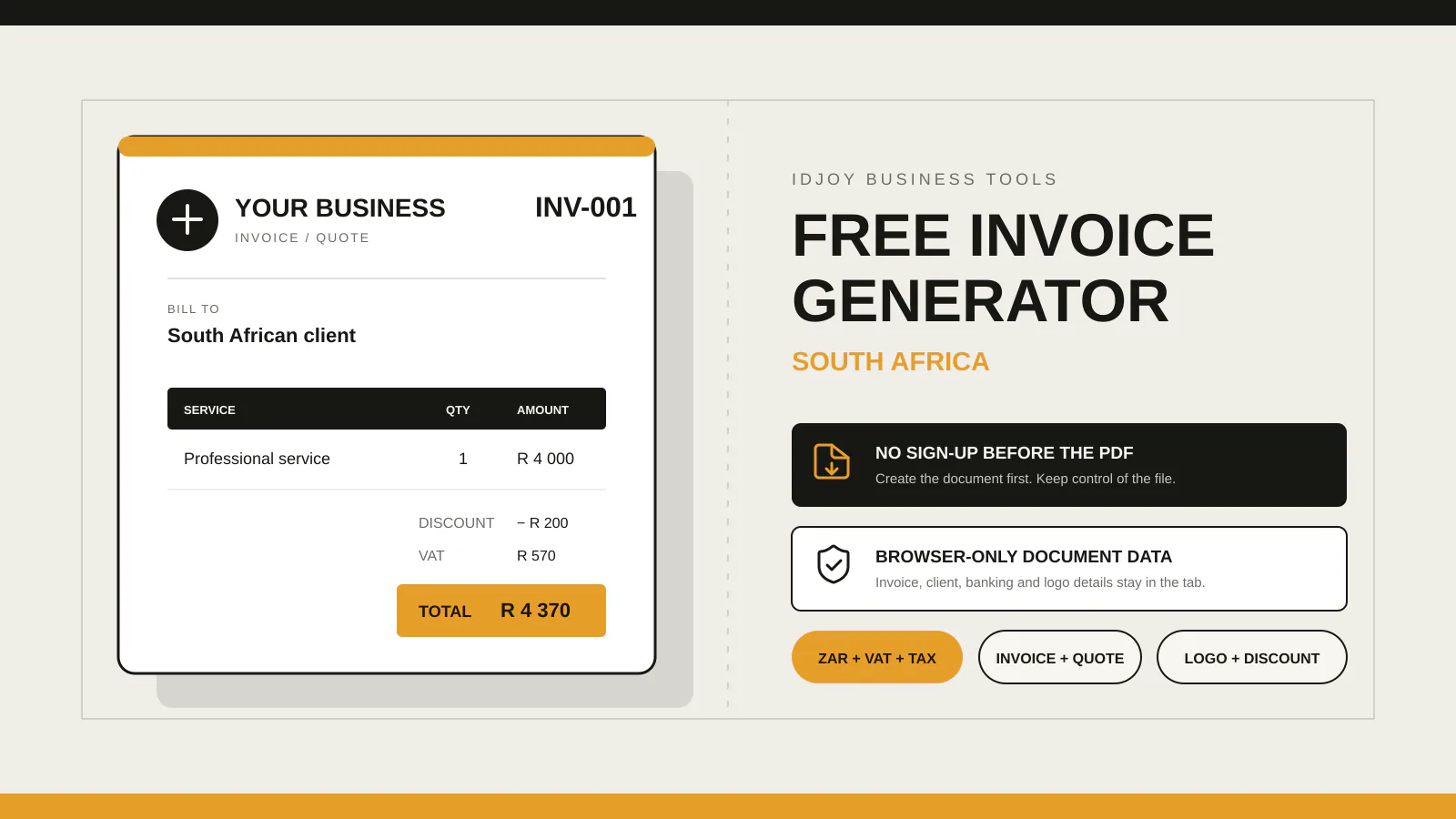
The free IDJoy Invoice Generator lets the user choose a quote or invoice and add optional VAT or TAX calculations.
It does not know the supplier’s SARS registration status, effective date or the VAT classification of the supply.
That is intentional.
Use the tool to build the document after the business has made the correct tax decision.
You can open the free IDJoy Invoice Generator and create the PDF without an account or stored client data.